

What Does The Bible Say About What Happens When You Die?
There are many important teachings in the Bible about what happens to us once we die. Some of the most important are:
Death is Not The End of Existence
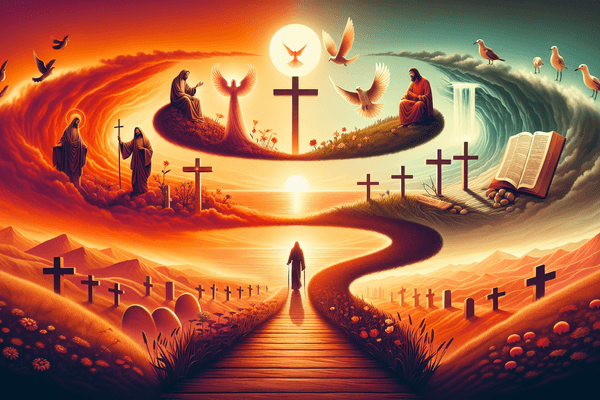
After we pass away, according to some, we essentially stop being. Human consciousness emerges gradually as the brain matures, and will inevitably decline or vanish entirely. But the Bible says something else entirely. While our earthly bodies will eventually rot away at the end of life, the Bible promises that our spirits will remain on, either with God or forever apart.
Following two parables that shed light on the reality of God's kingdom, Jesus spoke about a time when He will divide the "sheep from the goats" in Matthew 25. He sacrificed Himself so that the righteous would have eternal life, but the wicked will "go away to eternal punishment" (Matthew 25:45).
So, even though our last resting place may seem very different, eternity is waiting for us all. What happens to your body when you die is separate from what God has in store for your soul.
Death Must Not Be Feared
As His cherished creations, we should never be afraid, confused, or uncertain of anything. He gives us a sure, magnificent, and joy-filled home in Christ, a future apart from suffering and death. Anyone who puts their faith in Jesus and the sacrifice He made, rather than in themselves or their own merit, is welcome.
The Bible states that we are granted admittance into heaven when we accept that Christ is who He claims to be—the spotless Son of God—and that He died on the cross for our sins and rose again. Our Savior grants us unrestricted, relational intimacy.
Our lives are held in the same divine hand that holds the universe, both now and forevermore. So, when our bodies give out or disease strikes, we can take comfort in the knowledge that our love for God is unfaltering and unshakeable.
Saying Goodbye to Our Loved Ones is not Forever
The death of a loved one might make us feel like we've lost a piece of ourselves. Our hearts break for the shared experiences we will never have again and for the hopes and ambitions that may never come true. Despite the intensity of the anguish, we can take comfort in the knowledge that our loved ones who are in Christ will be with us again in the resurrection.
The crucifixion and resurrection of Jesus Christ confirmed the prophecy in the Bible. Because of our faith in Jesus' atoning death and resurrection, we anticipate that God will reunite the dead with Him in the resurrection (1 Thes. 4:14). As a result, believers always look forward to reuniting with loved ones and never really say goodbye.
Is There Life After Death?
 Source: Freepik
Pieter Verster gives us a comprehensive view of life after death as depicted in the Bible. Many chapters in the New Testament discuss the idea of life after death, which is a major theme of the book. Although these writings offer insights into life beyond death, many details remain unclear.
Paul and the evangelists are among the New Testament writers who confirm life after death as a genuine experience before God. They present this notion as originating from their conception of God as the life-giving God. In Luke 12:35–48, 13:22–30, and 16:19–29, for example, Jesus discusses life after death and distinguishes between people in the hereafter. This is aptly shown by the story of Lazarus (Luke 16:19–31), in which a rich man suffers in agony for disobeying God and his neighbor. In contrast, Lazarus, a poor man, is carried to Abraham's bosom and experiences glory.
The New Testament is replete with references to an ultimate judgment, most notably Matthew 25:31–46. This verse speaks of the last judgment, in which people are divided into two groups: those who go to glory and those who suffer because of their past lives on earth.
Paul goes into more detail about life after death in his letters. Paul states in 1 Corinthians 15 that believers have the assurance of life beyond death because of Christ's resurrection. He compares the resurrection to a grain that falls to the ground and then grows into a new existence. This change represents the victory over death and the divine promise of the body's resurrection.
Despite its complexity, 2 Corinthians 5:1–10 provides insightful information on Paul's beliefs regarding eternity and life after death. Paul discusses his hopes and elaborates on his conception of eternal life, highlighting how fleeting life is on earth in contrast to eternal life with God.
In summary, the New Testament offers a complex view of life beyond death, continually reaffirming its existence in the writings of Paul and the teachings of Jesus. The writings place a strong emphasis on the resurrection's transformational power and the last judgment, which establishes each person's eternal destiny.
The message of the New Testament is unambiguous, even in the face of certain mysteries: life after death is a central tenet of Christian eschatology, which assures a continuation of existence in God's presence.
Get Closer to God Today
4.9
Average Rating
|Over 5 Million Downloads
Where Do You Go When You Die?
Heaven
In the Bible, heaven is depicted as the ultimate dwelling place of God and the righteous. It is a place of eternal peace, joy, and communion with God. In the New Testament, Jesus speaks of preparing a place for his followers in his Father’s house (John 14:2-3). The book of Revelation provides vivid imagery of heaven, describing it as a glorious city with streets of gold and gates of pearl (Revelation 21:21). It is portrayed as a place free from sorrow, pain, and death (Revelation 21:4), where the faithful will live in the presence of God forever.
Hell
Hell is described in the Bible as a place of punishment for the wicked. It is often depicted as a place of fire and torment. In the New Testament, Jesus frequently refers to hell using the term "Gehenna," a place where the fire never goes out (Mark 9:43). The parable of the rich man and Lazarus (Luke 16:19-31) illustrates hell as a place of suffering and regret, contrasting with the peace of being with Abraham. Revelation describes a lake of fire as the second death, where the wicked are eternally separated from God (Revelation 20:14-15).
Resurrection
The concept of resurrection is central to Christian belief. The resurrection of Jesus Christ is the cornerstone of Christian faith, symbolizing the defeat of death and the promise of eternal life. Paul’s letters, particularly 1 Corinthians 15, expound on the resurrection, explaining that Christ’s resurrection is the "firstfruits" of those who have fallen asleep (1 Corinthians 15:20). Believers are promised a resurrection body, transformed and imperishable, likened to a seed that is sown in dishonor but raised in glory (1 Corinthians 15:42-44).
Other Concepts
- Sheol and Hades: In the Old Testament, Sheol is depicted as a shadowy place where the dead reside (Ecclesiastes 9:10). It is a place of stillness and darkness, distinct from the later Christian conceptions of heaven and hell. In the New Testament, Hades is used similarly, representing a temporary state of the dead until the final judgment (Revelation 20:13).
- Paradise: Jesus mentions "paradise" to the thief on the cross, promising him that he will be with Him there (Luke 23:43). This term is often interpreted as a temporary place of blessedness for the righteous before the final resurrection.
- New Heaven and New Earth: Revelation speaks of a new heaven and a new earth, where God will dwell with His people in a renewed creation (Revelation 21:1-3). This vision combines elements of heaven and earth, depicting a final, eternal state where heaven and earth are united.
What Happens to Your Soul When You Die?
 Source: Unsplash
R.C. Sproul gives us a comprehensive answer to this question. The conventional wisdom holds that after physical death, one's soul travels to live on in the presence of God. Even after physical death, our spirits carry on living, therefore there is no end to the continuity of life.
Some people's worldviews have been shaped by psychopannychia, which is more commonly referred to as soul sleep. According to this theory, once a person dies, their soul enters a kind of suspended animation. It sleeps, in a subconscious condition, until the great resurrection, when it is roused. There is no awareness of the passage of time because the soul is still alive but unconscious. The euphemisms used by the New Testament to describe the dead as sleeping leads one to this conclusion. "Asleep" is a frequent Jewish term that denotes the calm, contented state of mind experienced by individuals who have departed from this world and are now in God's presence.
However, the overarching message of Scripture is one of continuity, even in the Old Testament, when Abraham's bosom was considered as the location of the hereafter. Living here on earth is good, but taking part in the ultimate resurrection is the pinnacle of human achievement, as Paul expressed it. However, it becomes better in the intermediate state.
Paul had conflicting desires: first, to die and be with Christ, which is more desirable, and second, to live and carry on his vocation here on earth. We can deduce something from this and many other texts, but the apostle's opinion that the transitional state beyond the veil of death is superior to this one is particularly instructive.
Who Was The First Person on Earth to Die?
Adam and Eve had two sons: Abel and Cain. Their tale is told in Genesis 4:1-16.
Cain was the older of the two brothers. Cain farmed the land, while Abel became a shepherd. The two brothers brought sacrifices to God: Cain gave God the firstborn of his flock and the fruits of the land, while Abel gave God the fat parts of his animals. God accepted Abel's sacrifice with favor, but God turned down Cain's offering, leaving him bitter and resentful.
God warned Cain not to let his wrath and the possibility that sin would dominate him get the best of him. But this didn't stop Cain from inviting Abel to join him in the field. The first murder in the Bible was committed there when Cain attacked and killed Abel.
Cain said, "I don't know. Am I my brother's keeper?" in response to God's question about Abel's whereabouts. Aware of what had transpired, God approached Cain with his sin. God cursed Cain as a punishment, saying that he would no longer be able to grow crops and that he would be a wandering nomad. In spite of his punishment, God spared Cain's life by marking him so no one else could kill him.
Get Closer to God Today
4.9
Average Rating
|Over 5 Million Downloads
Conclusion
The Bible teaches that death is not the end but a transition to an eternal destiny. Jesus’ parables, like the division of the "sheep from the goats" in Matthew 25, highlight the eternal outcomes of our choices. Heaven is described as a place of peace and joy with God, while hell is a place of punishment.
Central to Christian belief is the resurrection of Jesus, which signifies the defeat of death and the promise of eternal life. Paul’s letters, particularly 1 Corinthians 15, assure believers of a transformed, eternal body.
Despite some mysteries, the Bible’s clear message is that life after death is a fundamental Christian belief. It offers hope, comfort, and the promise of continued existence with God. Faith in Jesus Christ promises a future free from suffering and reunion with loved ones in the resurrection.