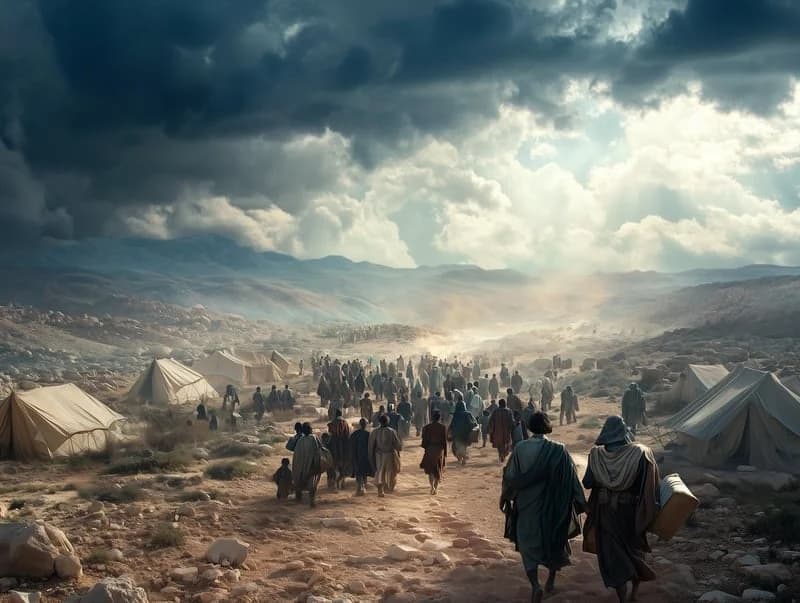
Wilderness and Exile
This 7-day Bible study invites you to explore the powerful themes of wilderness and exile throughout Scripture—seasons marked by isolation, waiting, and uncertainty, yet filled with the quiet work of God. From the Israelites wandering in the desert to individuals like Elijah, David, and the exiles in Babylon, the Bible shows us that these barren places are not empty of purpose. They are often the very settings where God refines His people, deepens faith, and prepares them for what’s next.
The plan is free to read here. In the app it arrives one day at a time, with the full passage and audio.
What the plan covers
- Day 17 min
The Law at Sinai – A Call to Holiness
Passages: Exodus 19:5 · Exodus 20:1
After delivering Israel from Egypt, God led His people to Mount Sinai, where He established a covenant with them. This was not just a set of rules but a divine calling—a guide for living in communion with a holy God. The Ten Commandments were given as a foundation, revealing God’s character and His desire for His people to walk in righteousness. Before giving the law, God reminded Israel of His grace: “I am the Lord your God, who brought you out of the land of Egypt, out of the house of bondage” (Exodus 20:2). This was crucial—obedience to the law was not about earning salvation but responding to the salvation they had already received. The commandments were given to shape their identity as a holy nation, set apart for God’s purposes. Holiness was not just about external behavior but about the heart. To have “no other gods” meant to live with undivided devotion to the one true God. The law was not meant to be a burden but a guide leading to life, pointing forward to the ultimate fulfillment in Jesus Christ. Through Him, we are called into holiness, not by our own strength but by His grace. The law also revealed humanity’s inability to achieve righteousness on its own. The people of Israel, despite their commitment, would repeatedly fall into disobedience. This is why Jesus came—not to abolish the law but to fulfill it (Matthew 5:17). In Him, the righteousness the law demands is fulfilled, and through His Spirit, we are empowered to live holy lives. At Sinai, God was shaping His people into a “kingdom of priests and a holy nation” (Exodus 19:6). Today, through Christ, we inherit this calling. We are invited to live not under the weight of the law but in the freedom of grace, walking in obedience out of love for the God who first loved us. Reflection How does understanding God’s grace help you see His commandments in a new light? Are there areas in your life where you struggle with obedience? How can you surrender them to God? What does it mean for you to be part of God’s holy nation today? Practical Steps Reflect on the Ten Commandments and ask God to reveal areas where He is calling you to deeper obedience. Spend time in prayer, committing to love and follow God’s ways not out of obligation but gratitude. Read Matthew 5:17–20 and consider how Jesus fulfills the law, inviting us into a relationship of grace and holiness. Prayer Heavenly Father, thank You for calling me to holiness. Help me to walk in obedience, not out of duty but out of love for You. Thank You for Jesus, who fulfilled the law and made a way for me to live in Your grace. Shape my heart to desire what is good and to reflect Your holiness in all I do. In Jesus’ name, Amen. - Day 27 min
The Wilderness – Trials and Trust
Passages: Deuteronomy 8:2 · Numbers 14:11
The wilderness is a place of testing, transformation, and trust. After their miraculous deliverance from Egypt, the Israelites expected an easy journey to the Promised Land. Instead, they found themselves wandering for forty years, facing hunger, thirst, and trials that tested their faith. Yet, this period was not a punishment without purpose—it was God’s way of refining their hearts, teaching them to trust Him daily. Deuteronomy 8:2 reveals that God led them through the wilderness to humble and test them, exposing what was truly in their hearts. He provided manna from heaven, a daily reminder that they could not rely on their own strength but on His provision. Yet, time and again, they grumbled, doubted, and longed to return to Egypt rather than press forward in faith. Numbers 14:11 captures God’s grief over their unbelief. Despite witnessing miracles—the parting of the Red Sea, water flowing from a rock, bread falling from heaven—their hearts remained hardened. Instead of trusting the One who had already delivered them, they focused on their immediate struggles. Their failure to trust God not only prolonged their journey but kept an entire generation from entering the land He had promised. The wilderness is more than a physical location; it is a spiritual experience. We, too, go through seasons of dryness, uncertainty, and waiting. In those moments, God is testing our hearts—not to destroy us but to strengthen our trust in Him. Just as He provided manna for Israel each day, He provides grace for our daily needs. The wilderness is not a place of abandonment but of preparation. God uses trials to deepen our dependence on Him, shaping us for greater things ahead. Ultimately, Jesus is our true provision in the wilderness. He is the Bread of Life, the living water that quenches every thirst. Where Israel failed in trusting God, Christ succeeded. In our trials, we look to Him—the One who endured the ultimate wilderness of the cross and made a way for us to enter eternal rest with God. Reflection What “wilderness” experiences have tested your trust in God? How has God provided for you in ways you didn’t expect? What steps can you take to trust Him more in uncertain times? Practical Steps Reflect on past trials and identify how God used them to strengthen your faith. Start a daily gratitude journal, listing ways God provides for you each day. Spend time in prayer, surrendering any doubts or fears, and asking God to increase your trust in Him. Prayer Heavenly Father, I thank You for leading me, even in seasons of wilderness. Help me to trust You when I do not see the way forward. Strengthen my faith and remind me that You are my daily provision. Teach me to rely on You completely, knowing that You are always faithful. In Jesus’ name, Amen. - Day 37 min
The Promised Land and Judges
Passages: Joshua 1:9 · Judges 2:18
After forty years of wandering, Israel finally entered the Promised Land. The Jordan River parted before them, just as the Red Sea had for their parents. This was the land of blessing, the inheritance promised to Abraham. But even as they stood in victory, God’s words to Joshua were a command to remain faithful: “Be strong and of good courage… for the Lord your God is with you wherever you go” (Joshua 1:9). Despite God’s guidance, Israel quickly fell into a dangerous cycle. The Book of Judges records a pattern of sin, suffering, repentance, and deliverance. When Israel obeyed God, they thrived. But as soon as they turned to idols and abandoned His commands, they suffered oppression from surrounding nations. In their distress, they cried out, and God, in His mercy, raised up judges—leaders who would guide them back to righteousness. Judges 2:18 tells us that God “was moved to pity by their groaning.” Even in their rebellion, He never stopped loving them. This cycle is not unique to Israel. It mirrors the struggle of every believer. We experience God’s blessings, yet how often do we drift away, drawn by distractions and temptations? The story of the Judges teaches us that though we may fall, God is always ready to restore us when we return to Him with repentant hearts. But Israel’s repeated failures also pointed to a deeper truth—they needed more than temporary deliverance; they needed a lasting Savior. The judges could only provide momentary relief. Their victories were fleeting, and Israel would always fall again. This pattern revealed humanity’s desperate need for Jesus, the true Deliverer who would break the cycle of sin once and for all. Through Christ, we are no longer bound to the endless cycle of sin and failure. His death and resurrection provide complete redemption. Now, when we stumble, we do not need another earthly judge to save us. We have an eternal Advocate in Jesus, who intercedes for us and calls us into a lasting relationship with the Father. Reflection Have you experienced cycles of drifting away from God and then returning to Him? How does God’s faithfulness in Israel’s story encourage you in your own spiritual walk? What steps can you take to break cycles of sin and fully embrace God’s call to faithfulness? Practical Steps Identify areas where you have struggled with repeated sin and commit them to prayer. Establish spiritual habits that keep you close to God—daily prayer, Scripture reading, and accountability. Remember that God is patient and merciful. If you have fallen, return to Him with confidence, knowing that He is eager to restore you. Prayer Heavenly Father, thank You for Your faithfulness even when I fall short. Just as You were patient with Israel, You are patient with me. Help me to learn from their story and walk in obedience to You. I turn away from anything that keeps me in a cycle of sin, and I embrace the freedom You offer in Jesus. Thank You for Your mercy and grace. In Jesus’ name, Amen. - Day 47 min
A Kingdom Built on God’s Grace
Passages: 1 Samuel 16:7 · 2 Samuel 12:13
Israel longed for a king. They wanted to be like the other nations, to have a ruler who would lead them into battle and secure their future. Despite God’s warning that earthly kings would bring both blessings and burdens, He granted their request and anointed Saul as Israel’s first king. Saul was everything they expected—tall, strong, and charismatic. But though he looked the part, his heart was far from God. His pride and disobedience led to his downfall, and God rejected him as king. Then came David. Unlike Saul, David was not chosen for his stature or skill but for his heart. He was a shepherd boy, overlooked by men but seen by God. “The Lord looks at the heart” (1 Samuel 16:7). David’s reign would be defined by both great victories and devastating failures. He was a man after God’s own heart, yet he was deeply flawed. His greatest moral failure—his sin with Bathsheba and the murder of her husband—revealed the brokenness even in the best of men. But what set David apart was his repentance. When confronted by the prophet Nathan, he did not justify his actions; he humbled himself, saying, “I have sinned against the Lord” (2 Samuel 12:13). And in God’s mercy, David was forgiven. After David came Solomon, the wisest of Israel’s kings. His wisdom was legendary, a gift from God. Yet even Solomon, with all his knowledge, allowed his heart to drift from the Lord. He built the temple, yet he also built altars to foreign gods. His divided heart foreshadowed the eventual division of the kingdom. Through these three kings—Saul, David, and Solomon—we see the tension between human weakness and divine faithfulness. No earthly king could fully satisfy Israel’s longing for a perfect ruler. Their successes and failures pointed forward to a greater King—Jesus Christ, the Son of David, whose kingdom would have no end. Where Saul was disobedient, Jesus was perfectly obedient. Where David sinned, Jesus remained sinless. Where Solomon’s heart was divided, Jesus’ heart was wholly devoted to the Father. Reflection How does David’s story of repentance encourage you in your walk with God? In what ways do you see the contrast between human kings and Christ, the true King? How can you cultivate a heart that seeks after God, like David? Practical Steps Spend time in prayer, asking God to reveal any areas where you need to repent and turn back to Him. Meditate on 1 Samuel 16:7, remembering that God values the heart above outward appearances. Reflect on Jesus as the perfect King and surrender any areas of your life where you struggle to trust Him fully. Prayer Heavenly Father, You see beyond appearances and look at the heart. Help me to seek after You with sincerity, just as David did. When I fall short, lead me to repentance and remind me of Your mercy. Thank You for sending Jesus, the perfect King, to reign in my life. May my heart be fully devoted to You. In Jesus’ name, Amen. - Day 57 min
The Prophets – God’s Call to His People
Passages: 1 Kings 18:21 · 2 Kings 17:13
Throughout Israel’s history, God sent prophets to call His people back to Him. Time and again, the Israelites drifted into idolatry, forsaking the covenant and following after false gods. The prophets were God’s voice, warning them of the consequences of their rebellion and urging them to return to the Lord. One of the most dramatic moments in prophetic history took place on Mount Carmel, where Elijah confronted the prophets of Baal. Israel had turned away from God, led astray by King Ahab and Queen Jezebel, who promoted Baal worship. Standing before the people, Elijah issued a powerful challenge: “How long will you falter between two opinions? If the Lord is God, follow Him; but if Baal, follow him” (1 Kings 18:21). The people were silent, torn between their desires and their calling. Elijah’s showdown with the prophets of Baal ended in fire—God sent a consuming blaze from heaven to prove He alone is the true God. Yet, despite this miracle, Israel continued to waver. This pattern of faithfulness followed by rebellion became the tragic cycle of Israel’s history. The prophets, however, never ceased to cry out. In 2 Kings 17:13, we see God’s heart: “Turn from your evil ways, and keep My commandments.” The Lord longed for His people to repent, to forsake their idols, and to return to the covenant. But they refused, and eventually, both Israel and Judah faced destruction, exiled from the land God had given them. Yet, even in judgment, God’s mercy remained. The prophets also spoke of a future hope—a day when God would restore His people and establish an everlasting kingdom. This hope was fulfilled in Jesus Christ, the greatest Prophet, Priest, and King. He, too, called people to repentance, saying, “Repent, for the kingdom of heaven is at hand” (Matthew 4:17). Through His life, death, and resurrection, Jesus accomplished what the prophets longed for—full restoration between God and His people. Reflection In what ways have you struggled with divided devotion, like the Israelites? How is God calling you to return to Him in areas of your life where you have drifted? What can you learn from the boldness of Elijah and the message of the prophets? Practical Steps Take time to reflect on any “idols” in your life—things that take priority over God—and surrender them to Him. Read through a prophetic passage (such as Isaiah 55 or Jeremiah 31) and meditate on God’s call to return to Him. Pray for a heart that is fully devoted to God, asking Him to remove anything that distracts you from His presence. Prayer Heavenly Father, You are the one true God, and I do not want to falter between two opinions. Forgive me for the times I have placed other things before You. Help me to turn back to You with my whole heart. Just as You called Israel to return, I hear Your voice calling me today. Lead me in Your truth and make my heart steadfast in You. In Jesus’ name, Amen. - Day 68 min
Exile – A Time of Purification
Passages: 2 Kings 25:21 · Lamentations 1:3
The Babylonian exile was one of the darkest moments in Israel’s history. Jerusalem, the city of David, lay in ruins. The temple—God’s dwelling place among His people—had been destroyed, and the people of Judah were carried away into captivity. The land of promise was lost, and they found themselves in a foreign land, under the rule of a pagan empire. But exile was not merely an act of punishment; it was a time of purification. The people had persistently turned away from God, following idols, breaking the covenant, and ignoring the warnings of the prophets. Even though He had been patient, their rebellion reached a point where God allowed judgment to come. Yet, even in discipline, His purpose was not to destroy but to refine them, to awaken their longing for Him once more. The book of Lamentations captures the sorrow of this period: “Judah has gone into captivity… she finds no rest” (Lamentations 1:3). The people mourned their losses, feeling abandoned, yet in their grief, they began to remember what they had forsaken. Their suffering stirred within them a renewed desire for God, a longing to be restored. In exile, the Israelites had no temple, no sacrifices, no land to call their own. They had only the Word of God, the stories of His past faithfulness, and the promise that one day, He would bring them back. This period led to spiritual renewal. Without the distractions of their former prosperity, they came to realize that their true identity was not in land or temple, but in their relationship with God. This mirrors the spiritual exiles we face in our own lives. There are times when we feel distant from God, when we suffer the consequences of disobedience, or when trials strip away our comforts. Yet, in those seasons, God is still at work, refining us, calling us back to Him. The exile prepared Israel for restoration, just as our trials prepare us for deeper communion with God. Ultimately, Jesus came as the fulfillment of this longing. He bore the ultimate exile—separation from the Father on the cross—so that we might be restored to God forever. Through Him, we are no longer captives; we are brought into the freedom of His kingdom. Reflection Have you ever experienced a season where you felt distant from God? How did it shape your faith? In what ways might God be using a difficult season to refine your heart and draw you closer to Him? How does the promise of restoration through Christ bring you hope today? Practical Steps If you feel distant from God, take time to reflect on what may be pulling you away and seek His presence through prayer and Scripture. Meditate on Lamentations 3:22–23, remembering that God’s mercies are new every morning. Find encouragement in knowing that exile is never the final destination—God’s desire is always to restore. Prayer Heavenly Father, even in seasons of distance, I know that You are near. If I have wandered, draw me back to You. Use every trial to refine my heart and deepen my trust in You. Thank You for the promise of restoration through Jesus, who suffered in my place so that I could be brought into Your presence forever. I trust in Your faithfulness. In Jesus’ name, Amen. - Day 79 min
The heart of God towards his people
Passages: Jeremiah 29:11 · Isaiah 49:15-16
Jeremiah 29:11 announces, “For I know the thoughts that I think toward you, says the Lord, thoughts of peace and not of evil, to give you a future and a hope.” Decades later, Isaiah 49:15-16 asks, “Can a woman forget her nursing child…? Surely they may forget, yet I will not forget you. See, I have inscribed you on the palms of My hands.” Together these promises reveal a Father whose heart stays open even when His children drift far away. Israel first heard Jeremiah’s words while exiled in Babylon, hearts aching with shame and homesickness. God did not scold; He spoke of shalom—wholeness that restores fractured identity. Neuroscience shows that when people experience secure attachment, the limbic system calms and the prefrontal cortex regains capacity for hope-filled planning. God offers exactly that internal safety: His steady regard remodels anxious neural pathways the way sunlight coaxes a winter tree to bud again. Isaiah pictures a nursing mother, the most instinctively attentive bond in creation, yet insists that God’s memory surpasses even hers. In Hebrew, inscribed means carved with a chisel; divine love is not written in washable ink but etched permanently. Theologically, this prefigures Christ’s crucified hands—love literally engraved in flesh—proving that covenant mercy outlasts our rebellion (Romans 5:8). Notice the Father’s posture: He does not merely wait; He longs. The verb in Isaiah 49:16 implies continual gaze. Like the father in Jesus’ parable who scans the horizon for the prodigal (Luke 15:20), God’s anticipation forms an emotional climate of welcome long before we turn the doorknob of repentance. Psychology names this unconditional positive regard; Scripture calls it grace. Yet divine longing is never passive. Verses 22-26 depict God raising a banner to gather dispersed children and contending with the forces that held them. The ancient Near-Eastern image is of a kinsman-redeemer who steps into legal battle for family. Addiction, trauma, and corrosive self-talk may enslave modern wanderers, but the Father redeems at neurological, relational, and spiritual levels. Studies in neuroplasticity show that repeated experiences of secure love can re-wire even entrenched patterns of compulsion, illustrating how grace partners with our biology to heal captivity. Attachment theory observes that when caregiving is steady and reliable, it forms in us an inner expectation of worth; when love is unpredictable, we slip into restless striving. The prophets affirm that God’s unwavering faithfulness repairs these distorted blueprints, training both soul and brain—including the default-mode network—to relax instead of replay anxious loops. Scripture and science together declare: secure love can retell our inner narrative, clearing fresh space for holy imagination. Therefore, self-awareness begins not with scrutinizing our failures but by beholding the Father’s unwavering affection. When we know whose we are, we can safely examine where we are. Exile turns to pilgrimage; wandering becomes a way home. Today, hear the resonance between Jeremiah’s future-hope and Isaiah’s engraved-hands: both invite you to rest in love strong enough to outlast exile and close enough to tattoo your name in glory. Reflection Where have you sensed “exile” in your own heart or habits? How does imagining your name engraved on God’s hands reshape your self-talk today? Which voices compete with the Father’s longing gaze, and why are they persuasive? Ask the Spirit to show you one memory where He was longing for you even then. Practical Steps Lectio Divina: Slowly reread Jeremiah 29:11, listening for the word or phrase the Spirit highlights; journal what future-hope He whispers. Attachment Repair: Spend five minutes of mindful breathing, picturing yourself held securely by God; let your body notice the safety. Reach Out: Share today’s insight with a trusted friend or mentor and invite them to pray Jeremiah 29:11 over you aloud. Prayer Father of engraved hands, thank You for thinking peaceful thoughts toward me even when I wander. Draw my restless heart into Your steady gaze. Rewrite my inner story with Your unbreakable covenant love and lead me from exile to home in Jesus’ name. Amen.