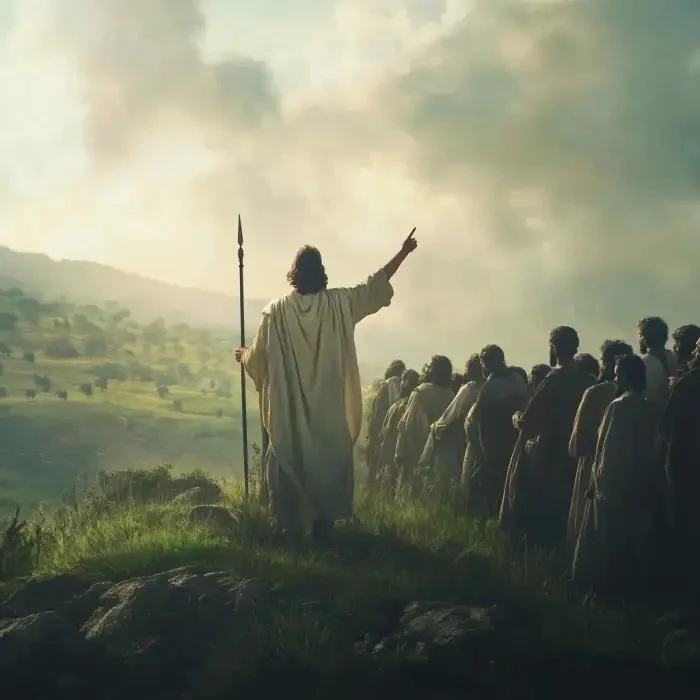
In Jesus’ Steps

7 dayssalvation

Embark on a seven-day spiritual journey to explore the pivotal moments of Jesus' life as depicted in the Scriptures. Each day focuses on a different aspect of His ministry, teachings, and miracles, helping you to deepen your understanding and strengthen your faith.

Start this plan in Bible Chat

The plan is free to read here. In the app it arrives one day at a time, with the full passage and audio.

What the plan covers

  1. Day 16 min

    The Birth of Hope

    Passages: Matthew 1:18-21 · Matthew 1:23

    Today, we embark on a journey of hope and fulfillment, starting with the miraculous birth of Jesus. In Matthew 1:18-21, we learn about the divine conception of Jesus, an event that set the foundation for our faith and the salvation of mankind. Joseph's initial reaction and the divine reassurance he received highlight the human experience intertwined with God's sovereign plans. Mary, a young woman from Nazareth, was chosen to bear the Savior of the world. This passage not only underscores her faith but also God's grace in choosing the humble and the faithful. Joseph's decision to stay with Mary after divine intervention shows us the importance of faithfulness and obedience to God's guidance, even when faced with situations beyond our understanding. Matthew 1:23 brings prophecy to the forefront, quoting Isaiah 7:14. 'Immanuel' - God with us, not just in spirit but in flesh. This prophecy and its fulfillment affirm God's constant presence and His plan of redemption that was set into motion centuries before. It reassures us that God's word is true, His plans are infallible, and His presence is eternal. The birth of Jesus was a beacon of hope then and now. It was the beginning of a new era where God came down to be with His people, to guide, to save, and to establish a relationship that transcends time and sin. This event is foundational not only because it marks the birth of Christ but because it signifies God's unwavering commitment to His creation. Reflection: As you reflect on these verses, consider the depth of God's love and the length He went to ensure our salvation. How does knowing 'God with us' change your perspective on the struggles or uncertainties you face? Let the reality of Jesus' birth renew your sense of hope and purpose as you walk with Him daily.

  2. Day 25 min

    The Baptism of the Savior

    Passages: Matthew 3:16-17 · John 1:29-30

    Today, we delve into the profound spirituality of Jesus' baptism, a pivotal moment that marks the beginning of His divine mission on earth. The baptizing of Jesus by John in the Jordan River is not only a ceremonial introduction but also a profound declaration of His messianic identity and mission. In Matthew 3:16-17, we witness a remarkable scene—the heavens open, the Spirit of God descends like a dove, and a divine voice affirms Jesus' sonship and God's pleasure in Him. This scene fulfills the prophecies and sets a divine seal on Jesus' ministry. It reveals the Trinity—Father, Son, and Holy Spirit—in a unique manifestation. The open heavens symbolize a new beginning, illustrating that with Jesus' arrival, a new era of openness between heaven and earth has begun. The descending dove, a symbol of peace and purity, signifies the anointing of Jesus for His ministry to bring reconciliation between God and mankind. In John 1:29-30, John the Baptist's declaration, 'Behold! The Lamb of God who takes away the sin of the world!' introduces Jesus not just as another teacher or prophet, but as the sacrificial Lamb. This title, 'Lamb of God', points to the ultimate sacrifice Jesus would make on the cross, highlighting His mission of redemption and the profound weight of His calling. John recognizes Jesus as preeminent and eternal, underlying Jesus’ divine nature and His preexistence before all creation. Reflection: As we reflect on Jesus' baptism, consider the significance of your own baptism or spiritual beginnings. Baptism symbolizes purification, a new start, and an identity as beloved children of God. How does knowing Jesus underwent baptism influence your understanding of your own spiritual journey? Does it inspire you to live out your identity as God's beloved with renewed commitment and understanding of your divine purpose?
  3. Day 35 min

    The Temptation in the Wilderness

    Passages: Matthew 4:1-4 · Matthew 4:10-11

    In the solitude of the wilderness, after a long fast of forty days and nights, Jesus encountered one of His greatest spiritual challenges: the temptation by the devil. This pivotal moment is not just a historical account but a profound lesson on spiritual resilience and reliance on God's Word. The first temptation focused on Jesus' physical need for food. The devil tempted Jesus to use His divine power to transform stones into bread. However, Jesus' response, quoting Deuteronomy 8:3, emphasizes that spiritual nourishment is more crucial than physical sustenance. This teaches us that in times of physical or emotional weakness, our primary source of strength should be the Word of God, not merely temporal solutions. The final temptation recorded here shows the devil offering Jesus all the kingdoms of the world if He would worship him. Jesus' response, referencing Deuteronomy 6:13, reaffirms His commitment to worship and serve only God. This moment highlights the importance of loyalty to God above all worldly offers and temptations. It reminds us that true authority and power come from God alone, and worshipping Him brings ultimate victory over evil. These temptations were real, and they were challenging, but Jesus overcame them by clinging to Scripture. Each response to Satan's provocations was rooted deeply in biblical truth, demonstrating how vital it is to know and understand the Scriptures to overcome life's temptations. Reflection: As you reflect on Jesus' temptation in the wilderness, consider the areas in your life where you might be facing temptations. Are you relying on your strength, or are you turning to God's Word for guidance and sustenance? Let Jesus' example encourage you to deepen your Scripture engagement, knowing that it is the sword of the Spirit (Ephesians 6:17), a powerful tool in all spiritual battles.
  4. Day 46 min

    Teachings on the Mount

    Passages: Matthew 5:1-3 · Matthew 5:17-19

    Jesus' Sermon on the Mount, particularly in Matthew chapters 5 through 7, presents foundational teachings that are as revolutionary today as they were at the time. In Matthew 5:1-3, we see Jesus ascending a mountain, a setting reminiscent of Moses receiving the Law. Here, Jesus begins his discourse, which is both comforting and challenging. The Beatitudes, starting with 'Blessed are the poor in spirit, for theirs is the kingdom of heaven,' offer a radical redefinition of happiness and success. Jesus commends humility, mournfulness, meekness, and a thirst for righteousness. This opening proclamation sets the stage for a kingdom whose values invert worldly expectations. The 'poor in spirit' acknowledges their spiritual bankruptcy and their utter dependence on God's grace. This disposition is essential for entering the kingdom of heaven, a theme of uttermost importance in Jesus' teachings. In Matthew 5:17-19, Jesus addresses a potential misunderstanding about His mission concerning the Law. He asserts that He has not come to abolish the Law or the Prophets but to fulfill them. This statement ties His teachings and life to the entirety of Hebrew Scripture. Jesus respects the Law, affirming its divine origin and eternal significance. His fulfillment of the Law is not merely in adherence but in embodiment and completion of its deepest intents. This continues His radical reorientation of His followers' understanding, emphasizing that adherence to His teachings is a deeper, more comprehensive form of obedience. Reflection: Today, reflect on the depth and radical nature of Jesus' teachings. How do the Beatitudes challenge your current views on happiness and success? Are there areas in your life where you can embody more fully the values of the kingdom of heaven? Consider how you approach the Law of God - not as a checklist to be accomplished, but as a guide to a deeper, fuller relationship with God through Jesus Christ.
  5. Day 58 min

    Miracles of Compassion

    Passages: John 6:5-13 · John 9:6-7

    In the miracles of Jesus, we find profound demonstrations of His divine power and deep compassion. The feeding of the 5000 and the healing of the blind man are vivid illustrations of how Jesus cares for both physical and spiritual needs of humanity. In John 6:5-13, we see Jesus addressing a practical need: hunger. With only five barley loaves and two small fish, Jesus feeds a multitude. This miracle is not just about the multiplication of food; it's a demonstration of Jesus' provision. He teaches us that with Him, little is much. When we offer what we have to Jesus, no matter how insignificant it may seem, He can use it to do great things. This story also reminds us of the importance of gratitude and stewardship, as evidenced by the collection of leftovers, ensuring that nothing was wasted. Similarly, in John 9:6-7, the healing of the man born blind highlights Jesus' power over physical ailments and His method in performing miracles—using simple elements like mud and saliva, combined with an act of obedience. This man's healing was not just physical but also symbolic, illustrating the restoration of spiritual sight. Through this miracle, Jesus shows that He is the light of the world who brings clarity and sight to our once darkened lives. Both of these miracles serve as powerful metaphors for Jesus' mission on Earth. They illustrate His concern for our entire being—body and soul. In feeding the 5000, Jesus addresses physical hunger, and in healing the blind man, He addresses spiritual blindness. Reflection: As we ponder these miracles, let us ask ourselves: What do we bring to Jesus? Are we willing to offer our humble resources for His purposes? And are we obedient to His commands, even when they seem simple or mundane? Let these reflections guide us in understanding that our faith, combined with Jesus' power, can lead to miraculous outcomes.
  6. Day 66 min

    The Transfiguration

    Passages: Matthew 17:1-3 · Matthew 17:5

    Imagine standing on a high mountain, the air crisp and clear, the solitude enveloping you and a select few. This was the setting for one of the most profound moments in Jesus’ ministry—the Transfiguration. This event, described in Matthew 17:1-3, is a pivotal moment where Jesus reveals His divine nature in a stunning visual display. His face and garments shine with a heavenly brilliance, symbolizing His purity and holiness. Moses and Elijah, representing the Law and the Prophets, appear alongside Him, signifying that Jesus is the fulfillment of both. This spectacular scene speaks deeply about Jesus' identity and mission. The presence of Moses and Elijah underscores Jesus as the continuation and fulfillment of God's promises throughout the Old Testament. It's a moment that bridges the past prophecies with the present reality of God's plan. The transformation of Jesus' appearance is a glimpse into His divine glory, affirming His deity and setting the stage for His ultimate sacrifice for humanity. Then, as if to remove all doubt, the voice of God the Father booms from heaven in Matthew 17:5, affirming Jesus’ identity as His beloved Son and commanding the disciples to 'Hear Him!' This divine endorsement emphasizes the importance of Jesus’ teachings and His unique role in the salvation history. It's a clear directive that Jesus is not just a wise teacher or a prophetic voice; He is the authoritative Son of God, whose words are life itself. This narrative is not just a historical event; it's a profound lesson on the nature of Jesus Christ and His relationship to God the Father. It also serves as a reminder of the transformation that Jesus desires for each of us—a transformation not of our outward appearance, but of our inner being, through a deep, personal relationship with Him. Reflection: As we reflect on the Transfiguration, consider how you perceive Jesus in your own life. Is He a distant historical figure, or is He your Lord, shining brightly, guiding your path with His teachings and transformed life? How can this magnificent revelation of His nature inspire you to listen more intently to His words and follow Him more closely?
  7. Day 75 min

    The Crucifixion and Resurrection

    Passages: John 19:16-18 · John 20:16-18

    As we conclude our journey through the life of Jesus, today's meditation centers on perhaps the most profound and transformative events of Christian faith: the crucifixion and resurrection of Jesus Christ. The scenes described in John 19:16-18 depict a moment of intense agony and sacrifice. Jesus, having been condemned by both the religious leaders and a Roman governor, carries His cross to Golgotha. This act is not just a physical burden, but a spiritual one, symbolizing the weight of all humanity's sins that He bore. As He is crucified, we are reminded of the depth of God's love for us, willing to suffer immensely to restore our broken relationship with Him. Transitioning to the scene in John 20:16-18, we witness a stark contrast: the sorrow of Friday turns into the joy of Sunday. Mary Magdalene's encounter with the risen Christ is a deeply personal and transformative moment. When Jesus calls her by name, it signifies the intimate relationship He desires with each of us. His instructions to Mary to go and tell His brethren about His resurrection highlight the importance of sharing this miraculous news. Jesus' resurrection is not just a victory over death, but a promise of new life for all who believe in Him. Reflection: Today, let us reflect on the personal significance of the crucifixion and resurrection. How does Jesus' journey from death to life inspire you in your daily challenges and in your spiritual walk? Consider the transformation in Mary's life when she encountered the risen Lord. Just as she was tasked to share the good news, we too are called to share the life-changing story of Jesus with others. How can you carry this message of hope into your world today?