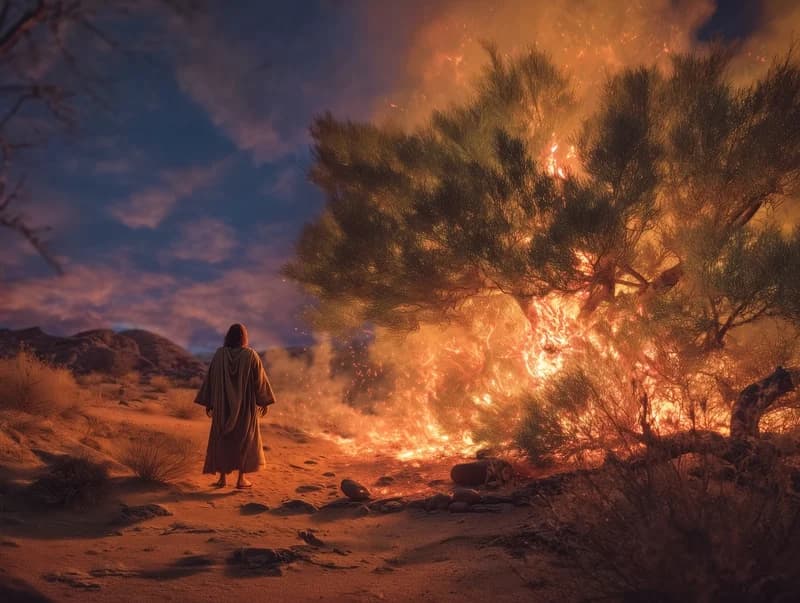
Moses: Trusting God Beyond Fear
This 7-day journey follows Moses from the burning bush to the Red Sea and the wilderness - showing how God’s presence turns fear and inadequacy into courage, obedience, and a faithful finish. You’ll learn to answer God’s call, face intimidation, wait well, and lead with integrity - while simple insights from psychology and neuroscience help you calm fear, reframe delay, and build resilient trust. Walk day by day with the God who says, “I will be with you,” and watch weakness become legacy.
The plan is free to read here. In the app it arrives one day at a time, with the full passage and audio.
What the plan covers
- Day 19 min
Called in the Fire
Passages: Exodus 3:4 · 2 Timothy 1:7
Fear is often the first response to God’s calling. When God met Moses at the burning bush, it wasn’t in a palace or a temple, but in a desert - the place of hiding. Moses had failed in Egypt, fled from his past, and settled into a quiet, predictable life. Yet it was in that wilderness, surrounded by silence, that God called his name. Theologically, this moment reveals the pattern of divine calling: God doesn’t wait for perfection before He calls; He calls us to reveal His perfection through our weakness. The burning bush symbolized a paradox - fire that did not consume. In the same way, God’s presence burns away fear without destroying the person. He calls ordinary people to extraordinary purposes so that His strength becomes visible through their frailty. When Moses heard his name, he responded, “Here I am.” That small phrase holds deep significance. It means availability, not ability. God never asked Moses for qualifications; He asked for willingness. What mattered most wasn’t Moses’ confidence in himself, but his confidence in God’s voice. Faith begins with showing up - trembling, uncertain, but present before the God who speaks. Psychologically, fear is a natural human response to perceived threat or inadequacy. When Moses protested, “Who am I that I should go to Pharaoh?” (Exodus 3:11), he expressed a common anxiety - the fear of not being enough. Neuroscience explains that when fear triggers the amygdala, the brain floods the body with stress hormones like cortisol, narrowing focus and heightening the sense of danger. But when trust is activated, especially trust in something greater than oneself, the prefrontal cortex engages, calming the emotional centers and restoring clarity. In simpler terms, believing in God’s presence literally helps the brain find peace. That’s why God’s response to Moses’ fear wasn’t a motivational speech - it was a promise: “I will certainly be with you.” (Exodus 3:12). God didn’t say, “You can do it.” He said, “I’ll be with you as you do it.” Theologically, that’s divine partnership - God’s presence transforms human limitation into divine possibility. Spiritually, the fire of God’s calling always exposes two things: our fear and His faithfulness. Moses felt unworthy, inadequate, and overwhelmed. But every fear became an opportunity for God to reveal His sufficiency. Fear says, “I can’t.” Faith says, “God can through me.” The same presence that burned in the bush would later fill Moses’ heart, giving him courage to face Pharaoh and lead a nation through the sea. Neuroscience supports this truth: repeated experiences of safety and trust actually reshape the brain’s wiring. As Moses experienced God’s faithfulness again and again - from the burning bush to the Red Sea - his mind and heart were transformed. What began as fear became familiarity with God’s voice. Repeated trust turns fear into confidence. When God calls us to something beyond ourselves, He’s not expecting perfection; He’s inviting partnership. Fear may whisper, “You’re not ready.” But faith answers, “God is with me.” The same fire that once terrified Moses would later rest upon him as glory. God never wastes a wilderness - He uses it to ignite courage that will burn brightly before kings. You don’t need to be fearless to be faithful. You simply need to trust that His presence is greater than your weakness. The One who calls you already knows your limits - and still says, “I will be with you.” Reflection: Where do you feel unqualified or afraid to step forward in obedience? How might God be inviting you to trust His presence instead of your ability? Practical Steps: Write down one fear that holds you back from obedience. Next to it, write God’s promise from Exodus 3:12 - “I will be with you.” When fear rises today, take a deep breath and say aloud, “God’s presence is my confidence.” Prayer: Lord, thank You that You call me even when I feel unworthy. Help me to trust that Your presence is greater than my fear. Burn away my doubts with Your love and give me courage to say “Here I am.” Amen. - Day 29 min
Trusting God When You Feel Inadequate
Passages: Exodus 4:10-12 · 2 Corinthians 3:5
Moses stood before the burning bush not only afraid of Pharaoh but afraid of himself. His past failures echoed in his mind, whispering, You’re not the one. He had fled Egypt as a fugitive, and forty quiet years in the desert had buried his confidence. When God called him to speak before kings, his first response was, “I’m not eloquent.” Beneath those words was a deeper cry: “I’m not enough.” Theologically, this moment teaches that divine calling exposes human weakness so that God’s strength can be revealed. God did not choose Moses for his eloquence but for his obedience. Heaven’s plan often begins with those who feel most unqualified. The miracle was not in Moses’ mouth but in God’s promise: “I will be with your mouth.” True confidence is not self-confidence - it’s God-confidence. Psychologically, feelings of inadequacy are rooted in comparison and past experiences of failure. When people focus on their limits, the brain’s limbic system interprets it as threat, releasing stress hormones that heighten self-doubt. Yet studies show that reframing weakness through supportive belief - such as trusting a faithful presence - reduces anxiety and restores clarity. Spiritually, that’s exactly what God did for Moses. He replaced fear with relationship: “I will teach you.” Neuroscience calls this relational regulation. When someone trustworthy is present, the nervous system calms, making courage possible. God’s words created that effect: His assurance activated Moses’ faith circuits, quieting the fear that had ruled him for decades. The presence of God is not merely emotional comfort; it’s a transforming force that rewires the brain toward peace. God didn’t deny Moses’ limitation; He redefined it. He reminded him, “Who made your mouth?” Every limitation we bring is already known by the Creator who designed us. What seems like weakness to us can become a window for His power. Moses’ slow speech would later highlight God’s miraculous message. The same voice that trembled before Pharaoh would one day declare the law before a nation. From a psychological view, owning weakness rather than denying it builds authenticity. When people admit their inadequacy but choose action anyway, their brains create new resilience pathways. Each act of obedience, even small, reinforces courage. Moses’ first step back toward Egypt rewired years of avoidance into trust. Spiritually, God delights in working through imperfection because it keeps glory where it belongs - with Him. When Moses hesitated, God provided Aaron, showing that partnership is part of divine design. Faith doesn’t erase dependence; it embraces it. Courage grows not from pretending we’re strong but from admitting we’re weak and still moving forward with God beside us. In time, Moses’ speech - once a source of shame - became the channel of revelation. He spoke the commandments, led worship, and interceded for Israel with words shaped by divine fire. This transformation began when he dared to trust that God’s “I will be with you” outweighed his “I can’t.” Today, God still calls ordinary people to extraordinary tasks. You may feel slow, inadequate, or unready, but grace specializes in working through trembling hands and uncertain voices. Your weakness doesn’t disqualify you; it qualifies you for partnership with God. The same One who made your mouth can fill it. The same Spirit who met Moses in fear now empowers you to step forward. Faith doesn’t deny insecurity - it walks through it, trusting that God’s presence is enough. Reflection: What areas of your life make you feel unqualified or inadequate? How might God be inviting you to depend more deeply on His sufficiency? Practical Steps: Write a list of three weaknesses and, next to each, write this truth: “God is with me here.” When self-doubt rises, pause and breathe slowly while saying, “My sufficiency is from God.” (2 Corinthians 3:5) Prayer: Lord, You know my weaknesses and still call me. Teach me to trust Your strength where I feel small. Be with my mouth, my mind, and my heart. Help me move forward, not in confidence of myself but in confidence of You. Amen. - Day 39 min
Faith That Faces Fear
Passages: Exodus 5:1 · Joshua 1:9
When Moses stood before Pharaoh, fear must have flooded his mind. The last time he had seen Egypt’s palace, he was running for his life. Now God was sending him back - not as a fugitive, but as a messenger. Every part of his natural self screamed, “This is impossible.” Yet faith whispers louder: “God is with me.” Theologically, this moment shows that courage is not the absence of fear, but the choice to obey in spite of it. God never told Moses he wouldn’t feel afraid; He simply said, “Go.” Fear may visit, but it doesn’t have to rule. Obedience, not emotion, defines faith. God’s call to stand before Pharaoh wasn’t about proving Moses’ strength but revealing God’s authority. Through each encounter, Pharaoh’s heart hardened, and Moses’ confidence in God deepened. Every “no” from Pharaoh became another opportunity for God to display His power. Faith grows strongest when circumstances refuse to cooperate. Psychologically, facing fear rewires the brain. When we confront what terrifies us rather than flee from it, the amygdala (the brain’s fear center) learns that the situation is survivable. Repeatedly choosing courage literally reshapes neural pathways, reducing future fear responses. Moses didn’t become fearless overnight - each act of obedience rewired his mind for trust. Spiritually, fear thrives where trust is absent. But courage is born in relationship with a faithful God. Each time Moses saw God’s hand - turning a staff into a serpent, dividing the waters, or protecting him from Pharaoh’s anger - his brain and heart were learning a divine pattern: God comes through. This repetition of rescue built resilience. Neuroscience calls this positive prediction bias - the more often you experience safety after risk, the more naturally your mind expects God’s faithfulness next time. When fear rises, the body reacts with racing heart, shallow breath, and tight muscles. God’s command, “Do not be afraid,” is not a denial of those feelings - it’s an invitation to refocus. Trust activates the parasympathetic nervous system, which slows breathing and calms the body. Prayer, praise, and deep breathing rooted in Scripture are spiritual tools that physically soothe the brain. That’s why courage grows stronger in worship. Moses’ courage also teaches that leadership often requires stepping into confrontation for the sake of others. He wasn’t just fighting for himself; he was standing between a nation and their oppressor. Fear becomes smaller when love grows larger. Scripture says, “Perfect love casts out fear.” When our motive shifts from self-preservation to God’s purpose, courage flows more freely. God’s presence transformed Moses’ trembling obedience into bold action. Each plague wasn’t just a miracle - it was a lesson in dependence. The more Moses trusted, the more his faith overshadowed his fear. His courage didn’t come from personality or training; it came from the assurance that he wasn’t standing alone. If you’re facing something intimidating - an uncertain future, a difficult conversation, a step of faith you feel unprepared for - remember that courage is built moment by moment. Every time you act in trust rather than retreat in fear, you strengthen both your spirit and your mind. The same God who stood with Moses before Pharaoh stands with you today. Faith that faces fear doesn’t promise comfort, but it guarantees company. You may still shake, but you’ll never stand alone. Reflection: What “Pharaoh” are you being asked to face - a situation or fear that feels too powerful? How can you rely on God’s presence instead of your feelings? Practical Steps: Before facing something intimidating, pause and pray: “Lord, go with me.” Visualize His presence beside you. Keep a courage journal - each time you step through fear, write down how God showed up. Prayer: Lord, when fear rises, remind me that You go before me. Give me courage to face what I cannot change and faith to trust what I cannot see. Thank You that Your presence turns fear into confidence. Amen. - Day 49 min
Faith in the Waiting
Passages: Exodus 6:9 · Psalm 37:7
Waiting is one of the hardest tests of faith. Moses obeyed God, spoke His words, and expected things to get better. Instead, Pharaoh made life worse for the Israelites. The people turned on Moses, accusing him of failure. God’s promise seemed distant, and Moses felt stuck between divine purpose and human disappointment. Theologically, this moment reveals that faith often walks through delay before deliverance. God had promised freedom, but He also planned formation. Waiting seasons are where faith grows from excitement to endurance. God doesn’t rush maturity. Every delay in Egypt was preparing Moses and Israel to see not just freedom, but the faithfulness of the God who brings it. Moses’ frustration - “Why have You sent me?” (Exodus 5:22) - was not rebellion; it was honest humanity. Scripture never hides the tension between promise and patience. God’s response to Moses wasn’t a rebuke but a reminder: “Now you shall see what I will do to Pharaoh.” (Exodus 6:1). When we feel delayed, God is often developing depth in us so we can carry the weight of His next move. Psychologically, waiting activates the same stress circuits as physical pain. The brain dislikes uncertainty; it seeks closure and control. That’s why delay can feel unbearable. But neuroscience also shows that hope changes how we wait. When people believe there is meaning or purpose in their delay, the brain releases dopamine - a chemical that sustains motivation and resilience. Spiritually, that’s the power of faith. Belief in God’s goodness transforms waiting from torment into training. Moses had to learn that leadership means trusting God’s timing even when others don’t understand. Waiting can make you feel powerless, but it’s in that powerlessness that dependence becomes real. Each time Moses returned to God in confusion, he was building spiritual muscle - learning to seek presence more than progress. Neuroscientists describe a process called neural adaptation - over time, the brain adjusts to long periods of waiting by forming new pathways for patience and emotional regulation. In the same way, prolonged seasons of spiritual delay reshape the soul. They teach us to live by truth rather than emotion. What feels like silence may actually be God strengthening your endurance. Spiritually, God uses waiting to shift our perspective. At first, Moses thought deliverance depended on Pharaoh’s permission. But through delay, he learned that freedom would come by God’s hand alone. Waiting purified his motives and deepened his vision. God wasn’t only freeing a people; He was forming a leader. Faith in the waiting says, “God hasn’t forgotten me - He’s still forming me.” Waiting doesn’t mean inactivity; it means intentional trust. Moses continued to show up, speak up, and step up even when results didn’t appear. That’s what mature faith does - it obeys in the dark and rests in God’s promise, even when emotions don’t agree. When life feels like a long pause between “promise given” and “promise fulfilled,” remember Moses. The same God who met him in disappointment is with you in delay. Your waiting is not wasted time; it’s sacred time. God is shaping endurance, deepening trust, and aligning circumstances for perfect timing. When God finally moved, everything happened suddenly - but the “suddenly” was built on years of slow preparation. Don’t rush what God is still refining. In His time, you will see that waiting wasn’t the gap between miracles; it was the ground where faith took root. Reflection: Where in your life do you feel delayed or overlooked by God? How might He be forming patience, strength, or deeper trust in that waiting? Practical Steps: Each morning, write one sentence beginning with: “Even while I wait, I will…” (trust, worship, serve, etc.) When impatience rises, repeat Psalm 37:7 aloud: “Rest in the Lord, and wait patiently for Him.” Prayer: Lord, teach me to trust You in the waiting. Help me believe that Your timing is perfect, even when I don’t see the reason for delay. Strengthen my heart to wait with faith and not fear. Amen. - Day 58 min
Faith at the Red Sea
Passages: Exodus 14:13 · Isaiah 43:2
Fear peaks when there’s no visible way out. Moses and the Israelites stood trapped between the Red Sea and Pharaoh’s army. The sand trembled beneath the horses’ hooves, and panic spread like fire. Yet Moses spoke words that cut through the fear: “Do not be afraid. Stand still, and see the salvation of the Lord.” Theologically, this was not denial of danger - it was declaration of faith. God had led them to the edge not to destroy them, but to display His power. When God brings us to impassable places, He isn’t testing His ability; He’s training our trust. The Red Sea was never a trap; it was a setup for a miracle. Psychologically, panic narrows our thinking. When the brain senses danger, the amygdala triggers fight, flight, or freeze responses. Logic fades, and fear dominates. Moses’ words, “Stand still,” were an invitation to regulate emotion through trust. When we pause and breathe instead of reacting, the body’s stress system slows, and the mind clears. Faith and calm are not opposites - faith produces calm because it anchors us in truth greater than our threat. Spiritually, the Red Sea represents every moment we face impossible odds. God could have taken Israel around the sea, but He led them through it. Why? Because walking through deep waters builds confidence in divine partnership. The miracle wasn’t just the water parting - it was the people learning that God’s presence could make a way where none existed. Neuroscience confirms that repeated experiences of deliverance rewire the brain to expect hope instead of despair. Each time we recall God’s faithfulness, new neural pathways form, making trust our default reaction instead of fear. That’s why remembering is a spiritual discipline - it transforms memory into momentum. Moses’ courage came not from self-assurance but from God-awareness. He had seen the bush burn without being consumed; he had seen Pharaoh fall silent before plagues. The God who started with fire would finish with water. Faith connects past victories to present battles, reminding the heart that the same God who was faithful is faithful still. The Israelites crossed on dry ground - but not before Moses lifted his hand in obedience. God often requires a step of faith before He shows His power. Fear says, “Wait until you see the way.” Faith says, “Move because God has spoken.” Sometimes, God doesn’t remove the sea; He parts it. He doesn’t erase the danger; He transforms it into deliverance. Every wall of water became proof that God’s authority was greater than nature, circumstance, or fear. When you face your own “Red Sea,” remember Moses’ words: Stand still. Stillness is not passivity; it’s spiritual posture - a heart anchored in trust even when everything shakes. God’s presence doesn’t promise smooth paths; it promises safe passage. Faith beyond fear sees the sea and still steps forward. Reflection: What “Red Sea” are you facing that feels impossible to cross? How might God be inviting you to trust His presence more than your perception? Practical Steps: When anxiety rises, pause for 30 seconds. Breathe slowly and repeat: “The Lord will fight for me.” (Exodus 14:14) Journal one past situation where God made a way when none seemed possible. Prayer: Lord, when I stand before impossible circumstances, help me to be still and trust You. Thank You that Your presence opens paths I cannot see. Teach me to move forward in faith, believing that You always make a way. Amen. - Day 67 min
Faith in the Wilderness
Passages: Exodus 13:21 · 2 Corinthians 12:9
Deliverance from Egypt was only the beginning. Freedom from bondage led straight into the wilderness - a place of hunger, thirst, and uncertainty. The same people who sang by the sea now questioned, “Is the Lord among us or not?” (Exodus 17:7). Yet through every challenge, God proved that His presence was constant. Theologically, the wilderness represents the journey between promise and fulfillment - a classroom where faith matures. God’s visible presence in the cloud and fire taught Israel that guidance doesn’t disappear when comfort does. The God who parted the sea now guided each step, showing that provision follows obedience. Psychologically, transition seasons unsettle us because the brain craves predictability. When routines break and uncertainty stretches on, stress hormones increase. But faith reframes the unknown as opportunity for growth. Neuroscientists call this cognitive reappraisal - seeing challenge as purpose-driven rather than threat-driven. Moses had to model this mindset for the people: each obstacle was not punishment but preparation. Spiritually, wilderness seasons detox the heart from dependence on visible security. Manna fell daily to teach trust in daily provision, not storage. God could have given them everything at once, but He chose to give just enough each day to train relationship. Dependence, not abundance, keeps the soul alive. The same pattern appears in neuroscience: gratitude and daily mindfulness strengthen resilience. Each time Israel thanked God for what they had - water, manna, protection - their collective morale lifted. When they complained, their stress increased. Gratitude literally rewires the brain for peace. Moses’ leadership in the wilderness also teaches emotional regulation under pressure. Surrounded by grumbling and fear, he repeatedly withdrew to pray. This pattern - retreat, pray, return - mirrors modern stress recovery cycles. Silence and connection with God reset both the mind and the nervous system. Moses learned that leading others begins with listening to God. The wilderness wasn’t meant to destroy them; it was meant to transform them. Every scarcity revealed a source: water from rocks, bread from heaven, victory from raised hands. The message was clear - God’s presence is greater than your weakness. If your current season feels barren or slow, remember that the wilderness is where revelation deepens. God uses solitude to strengthen faith and stillness to shape identity. The same presence that led Moses in fire and cloud now lives within every believer. You are never without direction when you walk in His Spirit. Reflection: What feels like a wilderness in your life right now? How can you look for signs of God’s daily presence instead of focusing on what’s missing? Practical Steps: Each day this week, write one “manna moment” - a small way God provided or guided you. Practice silence for five minutes daily; breathe slowly and focus on gratitude for His presence. Prayer: Father, thank You that You guide me even in dry seasons. Help me to see Your presence in small provisions and to trust that Your grace is enough each day. Amen. - Day 78 min
Faith That Finishes Well
Passages: Numbers 12:7 · 2 Timothy 4:7
Moses’ story began with fear, but it ended with faith. From the basket in the Nile to the burning bush, from Pharaoh’s court to Mount Nebo, his journey reveals one truth: trusting God transforms weakness into legacy. Theologically, Moses’ life demonstrates divine partnership - God didn’t choose a fearless hero but a hesitant man willing to follow. Through obedience, Moses became a vessel of deliverance, law, and leadership. His final moments weren’t of failure but of fulfillment. He saw the land from afar, a reminder that faith’s reward is not always seen in full on earth, yet the purpose is never wasted. Spiritually, finishing well requires sustained trust. Moses endured betrayal, disappointment, and fatigue, yet he never abandoned his calling. His strength came from intimacy - Scripture says he spoke with God “face to face.” Consistent communion turned insecurity into stability. Relationship with God is what sustains courage when circumstances no longer do. Psychologically, perseverance builds through consistent meaning. Studies show that people who live with a clear sense of purpose maintain motivation even in hardship. Moses’ purpose - to lead and serve God’s people - anchored him through every storm. Faith doesn’t remove struggle; it gives struggle meaning. Neuroscience supports this: purpose and gratitude reduce burnout by releasing dopamine and oxytocin - chemicals that promote endurance and peace. Every encounter with God renewed Moses’ brain and heart for the next challenge. Regular presence produced resilience. Moses’ legacy wasn’t perfection but faithfulness. Even when he faltered in anger, God still called him faithful. Heaven’s measure of success is not flawlessness but obedience. Moses finished well because he kept returning to God, no matter how heavy the burden. As we look at his life, we see a clear pattern: fear met with calling, calling refined by waiting, waiting strengthened by presence, and presence culminating in purpose. The same God who turned a stuttering shepherd into a nation’s deliverer still works through our fears today. Faith that finishes well refuses to quit even when the destination isn’t visible. Moses didn’t step into the Promised Land, but he led others to its border. Sometimes God calls us to prepare paths others will walk. Legacy is not about how far we go; it’s about how faithfully we follow. When Moses stood on Mount Nebo, looking across to the land, his eyes were not on what he missed but on the faithfulness of the God who had carried him every step. Trust beyond fear leads to peace beyond circumstance. Reflection: What does “finishing well” look like in your life right now? How can you remain faithful to what God has entrusted to you even when results seem incomplete? Practical Steps: Write down your “faith milestones” - moments where God proved His faithfulness. Reflect on how far He’s brought you. Commit one area of your life to finish well this week - relationship, responsibility, or spiritual habit. Prayer: Lord, thank You for Moses’ example of courage and perseverance. Help me to trust You beyond fear and finish my journey with faithfulness. May my life reflect Your glory and leave a legacy of obedience and love. Amen.