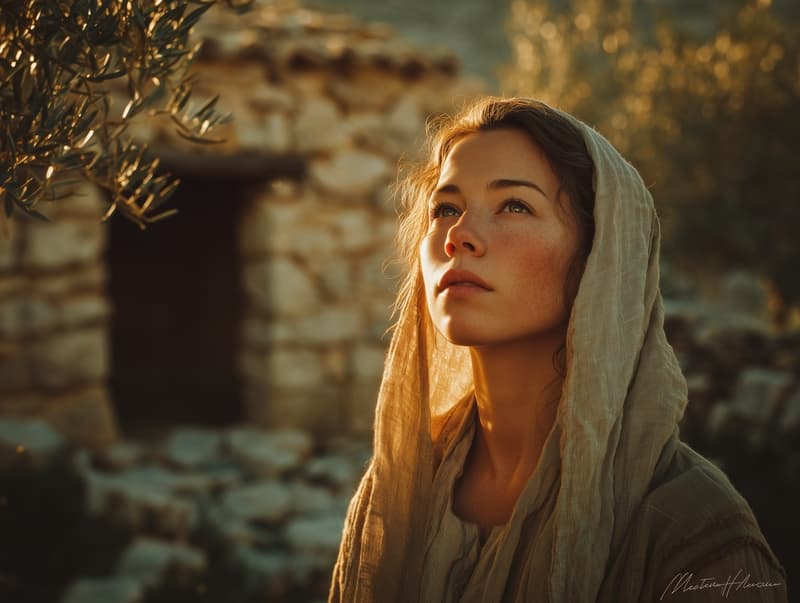
Mary: Faith That Says ‘Yes’ to the Impossible
7 days
This 7-day journey walks with Mary as she says “yes” to the impossible - choosing surrender over control, waiting with trust, and turning fear into worship. Each day blends Scripture with simple neuroscience and psychology to show how praising, pondering, and persevering reshape the heart and mind - so your small “yes” to God becomes a world-changing obedience.
Start this plan in Bible Chat
The plan is free to read here. In the app it arrives one day at a time, with the full passage and audio.
What the plan covers
- Day 19 min
The Call to Believe the Impossible
Passages: Luke 1:30 · Luke 1:37
When the angel appeared to Mary, her world changed in a moment. A young woman from a small town suddenly heard an unimaginable message: she would conceive and give birth to the Son of God. No one had ever experienced this before, and it defied every law of biology and logic. Yet, in that sacred moment, God was inviting her into a story beyond reason - a story that required faith. Mary’s response reveals the essence of real faith. She didn’t understand everything, but she said yes. “Behold the maidservant of the Lord! Let it be to me according to your word.” (Luke 1:38). This wasn’t blind faith; it was trusting faith - belief rooted not in what she could explain but in who God is. Theologically, faith doesn’t begin when we understand; it begins when we surrender. It’s not a denial of reason but a decision to let God’s Word define reality above reason. From a psychological perspective, Mary’s calm and trust under pressure show emotional resilience. Most people’s first reaction to uncertainty is fear. The human brain, especially the amygdala, activates a threat response whenever we face the unknown. But Mary’s peace came from a different source - divine assurance. When the angel said, “Do not be afraid,” that wasn’t just comfort; it was a neurological invitation to move from anxiety to trust. Studies show that belief in a higher purpose lowers stress, reduces cortisol, and activates hope pathways in the brain. Faith literally changes how we think and feel. Spiritually, Mary’s “yes” demonstrates that divine favor is not random - it’s connected to humility and surrender. God chose Mary not because she was powerful but because she was available. True favor often looks like an impossible assignment. It’s God saying, “I trust you to carry My promise.” Favor is not about ease but about purpose. It brings us to places where we depend completely on Him. Faith that says “yes” to the impossible is rarely convenient. It can bring misunderstanding, discomfort, and mystery. Yet it also opens the door to miracles. God’s plan didn’t need Mary’s understanding; it needed her willingness. The same is true for us. Many of God’s greatest works begin with a single word of agreement - yes. When we say yes, we align our limited life with His limitless power. Theologically, this shows how God partners with humanity. He doesn’t force His will; He invites cooperation. Mary’s story reminds us that God’s promises are often bigger than our capacity, yet never beyond His ability. Psychologically, saying yes to God activates what neuroscientists call cognitive reframing - shifting from “I can’t” to “God can.” This mental and spiritual reorientation builds resilience and peace even in the face of impossibility. Faith doesn’t mean we stop asking questions. Mary did ask, “How can this be?” (Luke 1:34). But she didn’t let the question cancel her obedience. Faith wrestles, but still obeys. That tension between wonder and surrender is where spiritual maturity grows. Every believer faces moments when God’s promises seem impossible - healing, restoration, calling, provision. Like Mary, we can choose to respond not with fear but with trust. Her story teaches us that divine miracles often begin in ordinary hearts willing to believe. Reflection: Where is God asking you to trust Him beyond what makes sense? What might saying “yes” look like for you in that area? Practical Steps: Write down one promise from God that feels “impossible.” Pray Mary’s words aloud: “Let it be to me according to Your Word.” Whenever fear rises, breathe deeply and repeat Luke 1:37 - “For with God nothing will be impossible.” Prayer: Lord, thank You for Mary’s faith that said yes even when she couldn’t see the outcome. Teach me to trust You the same way. Replace my fear with faith, my questions with surrender, and my logic with Your love. Let it be unto me according to Your Word. Amen. - Day 28 min
Faith That Chooses Surrender Over Control
Passages: Luke 1:38 · Proverbs 3:5
Faith begins where control ends. When Mary said, “Let it be to me according to your word,” she was surrendering her comfort, reputation, and expectations to God’s will. This wasn’t passive resignation - it was active trust. True surrender doesn’t mean giving up responsibility; it means giving up control of the outcome. Theologically, surrender is not weakness - it’s alignment. By saying yes, Mary positioned her will beneath God’s. That moment changed history. She didn’t demand clarity; she trusted the character of the One speaking. Faith doesn’t always come with explanation, but it always comes with presence. God’s promises may stretch us, but they never abandon us. Psychologically, control gives the illusion of safety. The brain releases dopamine when we feel “in charge,” and losing that control triggers anxiety. Yet faith invites us to rest in a deeper form of security - trust. Neuroscience shows that practicing surrender through prayer and meditation activates the prefrontal cortex (the brain’s peace center), calming the amygdala (fear center). Surrender literally rewires the brain to find peace in uncertainty. Mary’s “yes” was not just a statement; it was a lifestyle. For nine months she carried the promise in secret, surrounded by questions she couldn’t answer. She faced potential shame, rejection, and misunderstanding. But she didn’t fight for control; she leaned into trust. Her posture of surrender became the foundation for miracles. Spiritually, surrender is what allows God’s power to flow freely. As long as we cling to control, we block divine partnership. God doesn’t force His will - He looks for willing hearts. In surrender, we trade our plan for His purpose. That exchange is the soil of supernatural growth. Faith doesn’t silence fear - it chooses trust in spite of it. Mary may have felt fear, but faith spoke louder. Her obedience reveals that peace isn’t found in knowing the plan; it’s found in knowing the Planner. In life, God often asks us to release something before He reveals the next step - a dream, a timeline, or even control over what others think. Theologically, this reflects Jesus’ own life. He also said, “Not My will, but Yours be done” (Luke 22:42). Mary’s surrender prefigures Christ’s perfect obedience. Psychologically, surrender increases resilience. It shifts focus from outcomes we can’t control to relationships and values we can trust. When we yield to God, we activate hope instead of worry. Hope lowers stress, boosts clarity, and releases the brain’s healing chemicals. Faith that surrenders doesn’t demand proof. It rests in relationship. Like Mary, we can find peace not because we know the answers, but because we know the Author. Reflection: What area of your life are you still trying to control? What would it look like to release it into God’s hands and say, “Let it be to me according to Your Word”? Practical Steps: Write a “release list” of things you cannot control. Pray over each one. Whenever anxiety rises, whisper: “I choose trust over control.” End your day by thanking God for what you’ve released. Prayer: Lord, help me to trust Your plan even when I can’t see it. Teach me to surrender with peace, not fear. Like Mary, I say, “Let it be to me according to Your Word.” I choose faith over control. Amen. - Day 37 min
Faith That Endures Delay
Passages: Luke 1:45 · 2 Corinthians 5:7
After the angel’s message, Mary didn’t see instant results. Days turned into weeks before her body showed signs of pregnancy. Then months passed before the promise was born. Faith often requires waiting, and waiting tests what we truly believe. Theologically, delay is not denial - it’s development. God uses time to strengthen what faith has begun. Mary’s body became a living picture of spiritual truth: what God conceives in you grows slowly but surely. Every season of waiting has purpose. Psychologically, waiting is hard because the human brain dislikes uncertainty. It interprets “not yet” as danger. That’s why impatience triggers stress hormones like cortisol. But trust, hope, and gratitude calm the nervous system. Faith in God’s timing literally regulates emotional stability. When we choose to trust instead of panic, our brains produce serotonin - the chemical linked to peace. Spiritually, waiting transforms us. Mary’s nine months of quiet growth mirrored the slow unfolding of divine plans. Each day she nourished what no one could see yet. True faith doesn’t need visible proof - it trusts that God is working in hidden places. Delay reveals what we rely on most. When answers don’t come quickly, we discover whether we depend on circumstances or on God’s promise. The waiting seasons of faith are where roots grow deep. God often hides the miracle’s progress to protect it from doubt. Theologically, faith in delay mirrors Abraham’s belief and aligns with the principle that God’s timing is perfect. The moment we try to rush His plan, we risk stepping out of alignment. Mary didn’t try to explain or prove God’s work in her; she simply lived in quiet expectation. Psychologically, practicing patience strengthens emotional resilience. Studies show that those who delay gratification tend to have greater peace and perseverance. Spiritually, patience is faith stretched across time. Every believer faces seasons of invisible growth. You might pray and see no change, obey and feel no breakthrough, but like Mary, what’s conceived in faith is forming behind the scenes. Faith endures because it remembers: “There will be a fulfillment.” Delay does not mean abandonment. The God who begins a promise will complete it. Reflection: What promises are you waiting for right now? How can you nourish faith instead of frustration while you wait? Practical Steps: Write a “waiting declaration”: “Even if I don’t see it, I believe God is working.” Each morning, thank God for progress unseen. Read Luke 1:45 aloud whenever impatience rises. Prayer: Lord, help me trust Your timing. Teach me to see delay as preparation, not punishment. Like Mary, I believe that everything You promise will be fulfilled. Strengthen my heart while I wait. Amen. - Day 46 min
Faith That Magnifies God
Passages: Luke 1:46-47 · Psalm 34:3
When Mary visited Elizabeth, her first response was worship. Her soul overflowed in praise: “My soul magnifies the Lord.” Her circumstances were uncertain, yet her spirit rejoiced. Faith that magnifies God looks at life through the lens of His greatness, not the size of the problem. Theologically, to “magnify” means to make something appear larger. Of course, God can’t be made bigger - but He can become bigger in our perspective. Fear shrinks faith; worship expands it. Mary chose to focus on who God is rather than what she didn’t understand. Psychologically, gratitude and worship have measurable effects on the brain. They activate neural pathways of joy, reduce stress, and increase dopamine and oxytocin - the “peace and love” chemicals. That’s why worship is healing: it transforms our emotional state by shifting our focus from self to God. Mary’s song reveals the theology of faith and joy. She recognized that her miracle wasn’t about her greatness but about God’s grace. Her worship turned uncertainty into celebration. Faith that magnifies God turns fear into song. Spiritually, magnifying God breaks the cycle of anxiety. The more we fix our eyes on Him, the smaller our problems seem. Mary didn’t deny her situation; she declared God’s goodness within it. True faith doesn’t wait for the outcome to rejoice - it worships while waiting. Magnifying God also strengthens community. When Mary visited Elizabeth, both women’s faith grew. Worship is contagious; it creates shared hope. When we celebrate God’s faithfulness together, our collective faith multiplies. Psychologically, shared joy builds resilience. Studies show that communal gratitude amplifies positivity and increases hope. Spiritually, it fulfills God’s design for fellowship - lifting one another through worship and testimony. Mary teaches us that faith is not silent; it sings. Praise is a spiritual weapon that realigns the heart and rewires the mind. When we magnify God, we make room for miracles. Reflection: Do you focus more on your problems or on God’s power? How can worship become your first response instead of your last resort? Practical Steps: Begin and end your day with one sentence of praise. Write a short “Magnificat” of your own - three things you’re thankful for today. Play a worship song when you feel anxious or overwhelmed. Prayer: Lord, teach me to magnify You above every fear. Let my worship be stronger than my worry. Like Mary, may my soul rejoice in You daily. Amen. - Day 57 min
Faith That Perseveres Through Pain
Passages: Luke 2:34 · Psalm 34:19
Faith doesn’t protect us from pain; it gives purpose to pain. When Simeon spoke over baby Jesus, he blessed Him - and also warned Mary that her soul would be pierced. Even in the midst of joy, she learned that faith comes with a cost. The same “yes” that brought her a miracle would one day bring heartbreak at the foot of the Cross. Theologically, this reveals a profound truth: real faith doesn’t quit when life hurts. God never promised a life without suffering; He promised His presence in it. Mary’s journey reminds us that faith must mature from excitement to endurance. It begins with joy but deepens through surrender. Psychologically, pain challenges our sense of meaning. The brain naturally resists loss, disappointment, and grief, triggering stress and withdrawal. Yet neuroscience shows that when we frame pain through faith and purpose, the brain releases resilience chemicals - dopamine and endorphins - that help us heal. Faith literally helps the mind recover by assigning meaning to suffering. Mary’s faith held steady in seasons that made no sense - when she fled to Egypt, when she couldn’t find room in Bethlehem, when she stood beneath the Cross. Each moment invited her to trust that God was still working redemption through pain. The same God who brought life through her womb would bring salvation through her wounds. Spiritually, perseverance transforms us. Pain becomes a place of refining, where we discover the strength of God’s grace. In those moments when faith feels heavy, God invites us to depend on His endurance instead of our own. Persevering faith doesn’t say, “I can handle this.” It says, “God is with me in this.” Theologically, this mirrors Christ’s own suffering. Just as Mary’s “yes” led to the Cross, Jesus’ “yes” led to our salvation. Every act of surrender carries resurrection potential. Faith doesn’t erase pain - it redeems it. Psychologically, those who hold on to faith during loss tend to find deeper peace later. Belief helps the mind integrate painful memories with hope instead of despair. When we pray through pain, we give our brains a new narrative: “God is still here.” Faith that perseveres transforms wounds into worship. Mary’s tears became seeds of faith for generations. Her pain was real - but so was God’s promise. Reflection: Where in your life has faith cost you something? How can you allow pain to become a pathway for deeper trust rather than bitterness? Practical Steps: Write one sentence beginning with “Even in this, God is with me.” When pain surfaces, breathe slowly and whisper, “Your grace is enough.” Read Psalm 34:19 aloud each night this week. Prayer: Lord, when my heart feels pierced, remind me that You are still present. Teach me to see pain not as punishment but as part of Your purpose. Strengthen my faith to persevere like Mary, even through sorrow. Amen. - Day 67 min
Faith That Trusts God’s Plan
Passages: Luke 2:19 · Psalm 119:105
After the shepherds visited and shared what the angels told them, Mary didn’t rush to post or proclaim it - she pondered it. That word means “to weigh carefully.” Faith not only believes - it reflects. Mary shows us that trusting God’s plan often means holding things quietly in our hearts until He reveals their purpose. Theologically, pondering is part of faith’s process. It’s the sacred pause between promise and fulfillment. God rarely gives all the details at once because He invites relationship, not just results. Mary learned to walk step by step, not with complete understanding but with complete trust. Psychologically, reflection deepens resilience. When we slow down and meditate on truth, our brains integrate experiences more meaningfully. The hippocampus - the brain’s memory center - strengthens, and anxiety decreases. That’s why prayer and meditation bring clarity: they train the mind to rest instead of react. Mary’s quiet faith contrasts with our noisy world. We often want instant answers, but God’s plan unfolds slowly. His guidance is often more like a lamp than a floodlight - it shows the next step, not the entire road. Trusting His plan means being content with partial understanding. Spiritually, this teaches us that God values hidden seasons. Some promises are meant to grow in silence. Mary’s heart became a sacred place of incubation where revelation matured. What we ponder, we preserve. When we rush, we risk losing what God is forming within us. Faith that trusts God’s plan doesn’t need constant proof. It finds peace in God’s character. Theologically, this is the heart of discipleship - learning to follow even when we don’t fully see. Psychologically, delayed understanding teaches patience and emotional regulation. When we accept that not knowing is part of the journey, we reduce stress and increase joy. Faith literally trains the brain to tolerate mystery with peace. Mary’s pondering reminds us that stillness is not inactivity - it’s intimacy. Faith grows stronger in quiet reflection than in frantic striving. In silence, the Spirit shapes our understanding until what once confused us becomes clear. Reflection: Do you rush to understand everything God is doing? What might it look like for you to “ponder” instead of push for answers? Practical Steps: Take five minutes daily this week to sit in silence before God. Keep a “faith journal” to record what God is teaching you. When confused, say aloud: “I trust Your plan, even when I don’t see it.” Prayer: Lord, help me to rest in Your plan when I don’t understand. Teach me to ponder, not panic - to wait with peace, not worry. May Your Word guide my steps day by day. Amen. - Day 77 min
Faith That Changes the World
Passages: Luke 1:46 · Ephesians 2:8
Mary’s faith began with one small “yes,” but it changed the world forever. Through her obedience, God brought salvation into humanity. Her story shows that when we trust God with our ordinary lives, He does extraordinary things through them. Theologically, Mary represents what happens when faith meets favor. God’s grace chose her; her faith responded. Salvation always begins that way - God initiates, we respond. Every “yes” to God carries redemptive power that reaches beyond us. Psychologically, small acts of obedience build momentum. The brain’s reward system reinforces positive choices, making faith a growing habit. Each time Mary trusted, it became easier to trust again. Faith strengthens like a muscle - it grows with use. Spiritually, world-changing faith doesn’t always look dramatic. It looks like daily obedience, quiet consistency, and continual surrender. God transforms communities through those who simply say, “Let it be to me according to Your word.” Mary’s life reminds us that greatness is not measured by recognition but by faithfulness. She lived much of her story in hiddenness, yet the ripple of her obedience reached eternity. Theologically, Mary’s “yes” mirrors the Church’s calling - to carry Christ to the world. We, too, become vessels of God’s presence when we believe and obey. Every time we reflect His love, forgive when it’s hard, or trust when it’s scary, the world glimpses Jesus through us. Psychologically, faith that changes the world starts by changing our inner world. As we renew our minds with God’s truth, fear loses power and peace takes root. Studies show that sustained faith and gratitude reshape brain patterns, increasing joy and empathy - two traits that influence communities positively. Mary’s story ends not with her name exalted, but with God’s. That’s the goal of every believer - to live in such a way that people see His greatness, not ours. Your “yes” may not look world-changing today, but in God’s hands, it will echo through generations. Faith is never wasted when it’s surrendered to Him. Reflection: What could your “yes” to God look like right now? How might your obedience impact others in ways you can’t yet see? Practical Steps: Ask God to show you one small step of obedience this week. Share your faith story with someone - it may spark hope in them. Each morning, begin your prayer with, “Be it unto me according to Your word.” Prayer: Lord, thank You for Mary’s faith that changed history. Give me courage to say yes to You, even when it feels small or unseen. Use my life to reveal Your glory and bring Your love to the world. Amen.