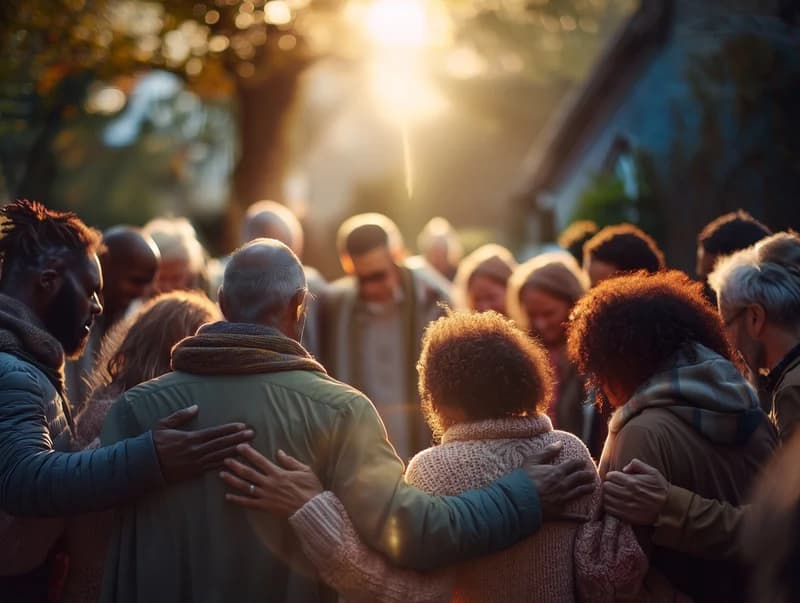
Community That Keeps Us Free from Offense

7 days

Build the kind of church family where offenses don’t take root. Across seven days you’ll practice quick repair, honest confession, and gentle boundaries; form accountability triads; establish encouragement rhythms; and craft a simple group covenant. With Scripture as your guide, you’ll cultivate a grace-forward culture - one that bears burdens, sharpens one another, and keeps relationships clean and strong in Christ.

Start this plan in Bible Chat

The plan is free to read here. In the app it arrives one day at a time, with the full passage and audio.

What the plan covers

  1. Day 18 min

    The Power of Forgiveness

    Passages: Proverbs 27:17 · Galatians 6:2

    From the very beginning, God designed His people for community. Adam was not left alone in the garden. Israel was called as a nation, not just individuals. The church was birthed as a Spirit-filled family of believers devoted to fellowship, teaching, and prayer (Acts 2:42). True Christian community is God’s chosen environment for growth, encouragement, and holiness. But community also brings friction. We are imperfect people walking closely together, and inevitably, offenses arise. Left unresolved, these offenses can calcify into bitterness, division, or withdrawal. But when handled within a Spirit-led, grace-forward community, offenses become opportunities for growth, deeper trust, and stronger unity. Proverbs 27:17 reminds us that “iron sharpens iron.” The sharpening process involves friction, but it results in greater effectiveness. Healthy community doesn’t avoid the sparks - it embraces them as opportunities for mutual sharpening. Galatians 6:2 adds that we are called to “bear one another’s burdens.” That means we don’t carry struggles alone. When offense or conflict threatens to isolate us, community steps in with accountability, encouragement, and restoration. Neuroscience and psychology echo this truth. Research consistently shows that people who live in strong, supportive communities have greater emotional resilience and lower levels of anxiety and depression. When individuals have safe, trusted relationships where they can process pain and receive encouragement, the brain’s stress response decreases, allowing for better problem-solving and healthier relational repair. Isolation, on the other hand, intensifies emotional pain and reinforces negative thought loops. Theologically, this makes sense. We are created in the image of a triune God - Father, Son, and Spirit existing in eternal relationship. To live in isolation is to live against the grain of God’s design. The Spirit equips the body of Christ to reflect that divine fellowship by practicing forgiveness, confession, and mutual support. What prevents offense from hardening is not perfection but practice: the practice of quick repair, the practice of humble accountability, the practice of regular confession and encouragement. A healthy community creates a culture where it is normal to say, “I was wrong, please forgive me,” and where forgiveness flows freely in response. Imagine a church culture where offenses were addressed quickly instead of buried. Where accountability triads (groups of three believers walking closely together) checked in regularly, not to shame but to strengthen. Where weekly rhythms of confession and encouragement kept hearts soft and relationships clean. That kind of community reflects Christ to the world. This week, we will explore practical ways to build such systems of accountability, confession, and encouragement. Together, they form a safety net that keeps offenses from becoming chains. Reflection: Do you view community as a place where offenses should be hidden or a place where they can be healed? How has isolation or unresolved conflict shaped your walk with Christ? Practical Steps: Reflect on one offense you may still be carrying. Share it with a trusted believer this week as a first step toward release. Begin praying for two or three people God may want to form into an accountability triad with you. Prayer: Lord, thank You for creating me for community. Teach me to embrace the sharpening of fellowship and to bear burdens with my brothers and sisters. Help me release offenses quickly and pursue peace with humility. Amen.
  2. Day 27 min

    The Gift of Confession

    Passages: James 5:16 · 1 John 1:9

    Confession is one of the most underused gifts God has given His people. In James 5:16, we are told that confession leads to healing - not only vertical confession to God but horizontal confession to one another. When paired with prayer, confession opens the floodgates of grace and freedom. We often think confession is about shame or exposure. But in Scripture, confession is about release. Hidden sin festers, growing heavier with secrecy. Neuroscience shows that secrecy activates the brain’s stress circuits. Keeping failures hidden produces chronic anxiety, rumination, and even physical stress symptoms. But verbalizing those struggles to a safe, trusted person relieves the brain’s load and releases oxytocin - a hormone connected with trust and bonding. Confession literally rewires the nervous system toward healing. 1 John 1:9 reminds us that confession is met with God’s faithfulness and forgiveness. In community, that forgiveness is echoed back through brothers and sisters who respond with prayer and grace. This creates what psychologists call a “corrective relational experience.” Instead of rejection, the vulnerable believer encounters acceptance and intercession. That experience makes them more likely to stay open in the future, preventing offense and bitterness from calcifying. Theologically, confession is an act of humility. It admits, “I cannot fix myself; I need grace.” This humility keeps the heart soft toward God and others. When confession becomes normal in a community, offense loses its power. People don’t have to carry grudges in silence - they can name them, repair them, and move forward in grace. Imagine a small group where confession is a weekly rhythm: believers sharing not only victories but failures, not only encouragements but honest admissions of weakness. That kind of rhythm keeps accounts short. Offenses don’t build up because they’re dealt with quickly. Pride doesn’t dominate because humility is practiced regularly. Grace flows freely because everyone is equally in need. Confession is not meant to be weaponized or gossiped about, but stewarded with gentleness. Communities that honor confidentiality and practice prayer after confession become safe havens where healing is normal. Reflection: When was the last time you confessed a struggle to another believer? What keeps you from confession - fear of judgment, pride, or habit of silence? Practical Steps: Write down one area where you need healing. Share it with one trusted believer this week. In your small group, set aside time for open confession and prayer. Prayer: Lord, teach me the freedom of confession. Help me to lay down pride and fear so I may walk in the light with my brothers and sisters. May our community be a place of grace, prayer, and healing. Amen.
  3. Day 37 min

    Practicing Quick Repair

    Passages: Matthew 18:15 · Ephesians 4:32

    Every community will experience conflict. The question is not if, but how quickly repair is sought. Jesus teaches in Matthew 18:15 that if a brother sins against us, we should go to him privately to seek reconciliation. The goal is not punishment but restoration: “you have gained your brother.” Ephesians 4:32 frames the posture we must carry into repair: kindness, tenderheartedness, and forgiveness. This posture reflects Christ, who forgave us first. Quick repair keeps offenses from hardening into bitterness. Psychologists call this practice rupture and repair. In every relationship, ruptures - moments of hurt, disappointment, or misunderstanding - are inevitable. What makes relationships healthy is not the absence of rupture but the presence of repair. Neuroscience shows that when repair happens quickly, the brain releases soothing neurochemicals like oxytocin, rebuilding trust. But when repair is delayed or avoided, the brain encodes the rupture as threat, creating distance and suspicion. Communities that practice quick repair train themselves to value unity over ego. Instead of waiting for the other to apologize first, each member takes responsibility to initiate. Instead of gossiping or withdrawing, they go directly to the person involved. Instead of stewing on offense, they speak the truth in love (Ephesians 4:15). Theologically, quick repair reflects the gospel. God did not wait for us to climb toward Him. He moved first through Christ. When we move quickly toward one another, we mirror His initiative. Quick repair says, “Our relationship is more important than my pride.” Practically, repair can be as simple as: “I realize I spoke harshly. I’m sorry. Can we talk?” “When this happened, I felt hurt. Can we clear the air?” “I don’t want this to come between us. Let’s pray together.” Notice that repair doesn’t require full resolution immediately. It starts with humility and willingness. When communities normalize quick repair, offenses don’t accumulate. The culture shifts from silent tension to active reconciliation. Members learn to see conflict not as a threat but as an opportunity to deepen trust and show grace. Reflection: How quickly do you seek repair when conflict arises? Do you tend to delay, hoping issues fade, or do you move toward reconciliation? Practical Steps: Identify one relationship in need of repair. Take the first step within 48 hours - whether a text, call, or face-to-face. Practice the Matthew 18 model: go privately, with humility, seeking restoration. Prayer: Lord, make me quick to repair when offenses arise. Help me value unity over pride and to forgive as You forgave me. Let my actions reflect Your heart of reconciliation. Amen.
  4. Day 47 min

    Accountability That Protects the Heart

    Passages: Proverbs 27:17 · Ecclesiastes 4:9

    The Bible presents accountability not as an optional extra but as a protective gift. Proverbs 27:17 paints the image of sharpening. Sparks may fly, but the result is a sharper edge - greater effectiveness. Ecclesiastes adds that two are better than one because they can lift each other when one falls. The Christian life was never designed to be walked alone. Yet for many believers, accountability is misunderstood. Some fear it feels like surveillance or control. Others think it’s only for “big sins.” In reality, accountability is about friendship, humility, and protection. It’s a structure that keeps us free from offense by ensuring we don’t carry hidden grudges or isolated struggles too long. Neuroscience and psychology confirm this truth. When we know someone will ask us about a particular area of struggle, our brain’s prefrontal cortex - the reasoning and planning center - stays more engaged. This creates a “pause button” before acting impulsively. Accountability acts like an internalized second voice, nudging us toward better choices. Psychologists also note that accountability helps break rumination cycles. When hurt or offense happens, isolated people replay it endlessly in their minds, reinforcing bitterness. But when they speak it aloud in a safe accountability setting, the narrative often shifts: they gain perspective, release pent-up emotions, and see the offense in light of grace. Theologically, accountability mirrors the way God designed the body of Christ. Romans 12:5 reminds us we are “members of one another.” My health impacts yours, and yours impacts mine. Accountability is mutual - we sharpen each other, lift each other, and remind each other of grace. One practical model is the accountability triad: a group of three believers who meet regularly to share honestly, pray, and encourage. Triads are small enough for vulnerability but strong enough for support. Within triads, simple yet powerful questions can be asked: Where have you struggled with offense this week? How did you seek repair or confession? Where can we encourage you and pray for you? In these spaces, confession becomes normal, forgiveness flows freely, and offense has no chance to harden into bitterness. Over time, triads build trust that keeps the heart tender and the community united. Accountability requires humility, because it means admitting weakness. But it also builds resilience, because it assures us we’re not alone. Communities that normalize accountability form a strong defense against offense, bitterness, and isolation. Reflection: Do you have people who know the real you - your struggles, temptations, and hurts? Or do you tend to carry things alone until they weigh you down? Practical Steps: Identify two trusted believers to form an accountability triad with. Share the vision and set a regular rhythm (weekly or biweekly). Write down three honest check-in questions you’d want your group to use. Prayer: Lord, thank You for the gift of accountability. Place people in my life who sharpen me, lift me, and keep my heart free from offense. Teach me to walk in humility and mutual support. Amen.
  5. Day 57 min

    The Rhythm of Encouragement

    Passages: 1 Thessalonians 5:11 · Hebrews 3:13

    Encouragement is not just a nice extra - it is a spiritual safeguard. Paul calls the Thessalonians to “comfort and edify one another.” The writer of Hebrews adds urgency: “exhort one another daily… lest any be hardened.” Encouragement is the daily vitamin that keeps hearts soft. Why is encouragement so powerful? Neuroscience shows that positive affirmation strengthens neural pathways associated with trust and safety. Encouragement literally builds resilience into the brain, lowering stress and making it easier to respond to challenges with grace instead of defensiveness. People who receive regular encouragement interpret others’ actions more charitably, making them less prone to offense. Psychologists highlight the protective power of encouragement. Communities saturated with affirmation develop higher relational trust, which acts as a buffer when conflicts arise. When we know we are valued and loved, small offenses are less likely to feel like rejection. Theologically, encouragement flows directly from God’s heart. He is called the “God of all comfort” (2 Corinthians 1:3). His Spirit is our Encourager, the Paraclete who comes alongside to strengthen. When we encourage others, we mirror God’s character, becoming agents of His grace. Encouragement is not mere flattery. It’s not saying nice things for the sake of it. True encouragement is Spirit-led recognition of Christ’s work in someone else: “I see Jesus in the way you serve,” or “Your patience reflects God’s grace.” This kind of encouragement roots identity in God’s work, not in human performance. Communities that adopt encouragement rhythms - regular practices of affirming and building up - become fertile soil for unity. Imagine if every small group ended with two minutes of encouragement per person, or if accountability triads began each session with words of gratitude for one another. These rhythms reshape culture. Encouragement not only strengthens individuals but also protects against offense at the communal level. A church known for encouragement becomes a place where grace flows more naturally than criticism. In such a culture, when offense arises, the relational bank account is so full of trust that repair is easier. Encouragement, practiced daily, creates an atmosphere where offense withers and grace thrives. Reflection: Do you tend to notice and speak encouragement, or do you assume people “just know”? How might God be inviting you to speak more words of life? Practical Steps: Choose three people this week to intentionally encourage. Be specific and point to God’s work in their lives. With your group, create a weekly rhythm of encouragement (e.g., affirm one another at the end of meetings). Prayer: Father, make me an encourager. Teach me to see others with Your eyes and to speak words that strengthen, heal, and protect against offense. Amen.
  6. Day 66 min

    Covenanting Together in Grace

    Passages: Amos 3:3 · 1 Corinthians 1:10

    Healthy community requires clarity. Amos asks, “Can two walk together unless they are agreed?” Paul pleads for the Corinthians to pursue unity and avoid division. Agreement doesn’t mean uniformity, but it does mean shared commitments. One way to cultivate this is through a community covenant - a short statement of values and rhythms that members agree to uphold. A covenant is not a contract or a legalistic rulebook. It is a shared declaration of intent: “This is how we will walk together in grace.” Neuroscience shows why this matters. When commitments are written down and publicly affirmed, the brain encodes them as identity markers. They move from abstract ideals to practical habits. Psychologists also find that groups with clear norms experience less conflict escalation because expectations are transparent. Theologically, covenants are central to God’s way of relating. He bound Himself to Israel through covenant, not because they were perfect but because He chose them in love. In Christ, we live under the new covenant of grace, secured by His blood. When we covenant with each other in community, we reflect God’s pattern: grace-filled commitment that fosters unity. A simple covenant might include statements like: We will confess quickly and forgive freely. We will encourage one another daily. We will repair relationships promptly when hurt arises. We will guard confidentiality and honor one another’s dignity. Such a covenant gives the community a framework for quick repair, accountability, and encouragement. It also sets the tone for newcomers: “Here, we practice grace first.” Over time, reviewing and re-affirming the covenant keeps hearts aligned. It reminds members that unity is not assumed; it is cultivated intentionally. When communities covenant together, offense loses its foothold. Instead of confusion or hidden expectations, there is shared clarity. Everyone knows the rhythms, and everyone commits to grace. Reflection: Does your community have shared commitments that guide how you handle conflict and encouragement? How might a covenant strengthen your group? Practical Steps: Draft a 3–5 sentence covenant with your group this week. Keep it grace-centered and simple. Revisit it quarterly to renew your shared commitment. Prayer: Lord, thank You for covenant love. Teach us to walk in unity by committing ourselves to grace, humility, and forgiveness together. Amen.
  7. Day 77 min

    A Grace-Forward Culture

    Passages: 1 Peter 4:8 · Ephesians 4:32

    The culmination of this study is a vision of a grace-forward culture - a community where love leads, forgiveness flows, and offense has no time to take root. Peter tells us that love covers a multitude of sins. This does not mean ignoring sin but choosing forgiveness and restoration over resentment. Paul adds that kindness, tenderheartedness, and forgiveness must shape our interactions, modeled after Christ’s forgiveness of us. Why does this matter? Neuroscience shows that people thrive in environments where grace is practiced regularly. When failure or offense is met with forgiveness rather than rejection, the brain associates community with safety, not danger. This allows vulnerability to flourish, building deeper trust. Psychologists confirm that cultures of grace are more resilient. In grace-forward communities, conflict is not feared but embraced as an opportunity for growth. Offenses are addressed quickly, forgiveness is extended freely, and encouragement saturates relationships. Such communities recover faster from ruptures and grow stronger through them. Theologically, grace-forward culture flows from the gospel. We live only by the extravagant grace of God in Christ. To withhold grace from others would be to deny the very gift we depend on. A grace-forward church doesn’t just preach grace; it embodies it in daily rhythms of confession, repair, encouragement, and accountability. Building such a culture requires intentional practices: Confession keeps hearts humble. Quick repair prevents bitterness. Encouragement rhythms strengthen bonds. Accountability triads protect from isolation. Covenants clarify shared commitments. Together, these form a system that keeps communities offense-free. Over time, these habits shape culture, and culture becomes identity. Imagine walking into a church where members regularly say, “I was wrong, please forgive me,” where encouragement outweighs criticism, where accountability feels like friendship, and where covenant commitments hold relationships together. That is the picture of a grace-forward culture - and it is both deeply biblical and profoundly healing. This is the call of the church: to be a living demonstration of the reconciling power of Christ. When communities embody grace-forward culture, they become safe havens of healing, sanctuaries of belonging, and witnesses to the watching world. Reflection: Does your community lean toward criticism and silence, or toward confession, repair, and encouragement? What one step could shift your group toward being more grace-forward? Practical Steps: As a group, choose one rhythm (confession, repair, encouragement, accountability, covenant) to practice consistently this month. As an individual, extend grace in a relationship today where offense has lingered. Prayer: Father, thank You for lavishing grace on us through Christ. Help our community overflow with grace so that love covers offenses, forgiveness flows freely, and unity reflects Your kingdom. Amen.